


Working from home may offer flexibility, but it can also create unexpected state tax obligations. As remote and hybrid work become established parts of the U.S. labor market, states are paying closer attention to where employees physically perform their jobs, where employers are located and which state has the right to tax employment income.
The issue is particularly important for workers who live in one state while working for a company headquartered in another. The Federation of Tax Administrators’ telecommuting resources highlights how state approaches to remote work taxation can differ significantly.
Why Remote Work Changed the Tax Equation
Before widespread telecommuting, an employee’s workplace and employer location were often close enough that state taxation was relatively straightforward. Remote work separated those two locations.
Today, an employee could live in New Jersey, work remotely for a New York company and occasionally travel to a Manhattan office. Depending on the circumstances, that arrangement can create resident and nonresident tax filing obligations.
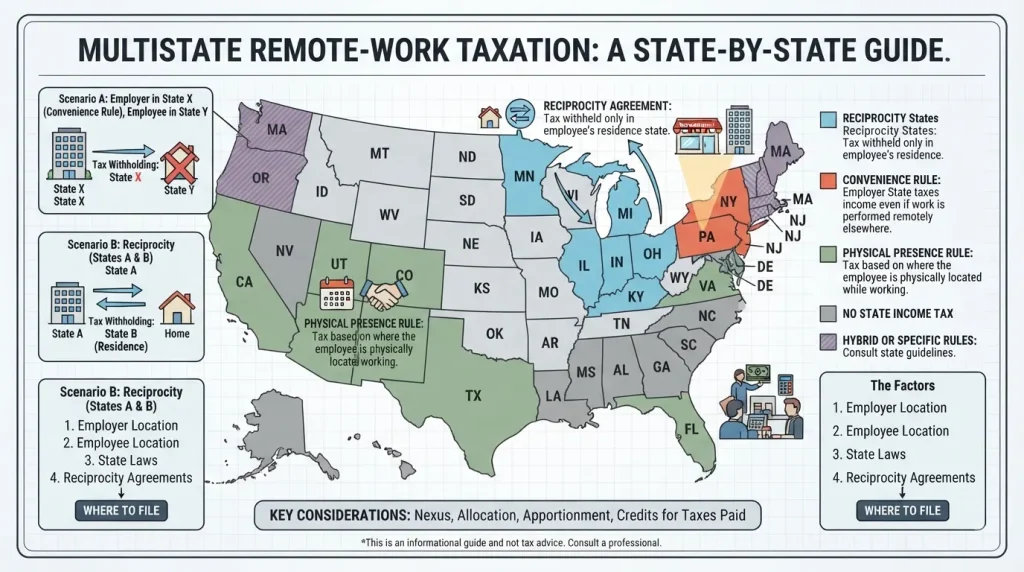
New York is one of the most closely watched examples. Its Department of Taxation and Finance guidance explains the state’s “convenience of the employer” approach. Under this framework, certain nonresident employees working outside New York for their own convenience can still have their wages treated as New York-source income.

The Convenience-of-the-Employer Rule
The “convenience of the employer” rule has become a major point of controversy in the remote-work era. Under this approach, some states can treat an employee’s remote work income as taxable by the employer’s state even when the employee is physically working elsewhere.
The Tax Foundation’s analysis of state nonresident taxation explains that only a limited number of states use these rules, but they can have significant consequences for interstate remote workers.
New Jersey has also addressed the issue. Its official convenience-of-the-employer FAQ explains how the state’s rules interact with employees who live in certain other states and work remotely for New Jersey employers.
States Do Not All Follow the Same Rules
There is no nationwide formula for determining where remote employees owe state income tax. Some states generally focus on the location where work is physically performed, while others have special sourcing rules or reciprocity agreements.
That means two employees with nearly identical remote-work arrangements could have very different tax obligations simply because they live or work in different states.
Massachusetts, for example, provides specific rules for nonresident employment income. Its official nonresident tax guidance explains how Massachusetts-source income can be determined for people who work both inside and outside the state.
Why Employers Are Paying Attention
The issue is not limited to employees. Businesses must also consider payroll withholding, employee locations, state registrations and other compliance obligations when workers operate across state borders.
For that reason, companies increasingly need accurate records of where employees perform their work and clear policies governing remote arrangements. A worker moving to another state without notifying the employer can create payroll and tax complications for both sides.
What Remote Employees Should Do
Remote employees should keep track of where they physically work during the year, particularly if they travel between states. They should also review their paystubs and year-end tax documents to see which states are reporting or withholding income.
If an employee moves during the year, the employer should be informed promptly so payroll withholding can be reviewed. Workers should also check whether their resident state provides a credit for taxes paid to another state.
The IRS tax resources can provide broader federal tax information, but state income-tax questions generally require checking the relevant state tax authority.
What Comes Next?
As remote work continues to blur traditional geographic boundaries, state governments face a difficult balancing act. States want to protect tax revenue while employers and workers increasingly expect greater geographic flexibility.
The debate could lead to additional legislation, court challenges, updated withholding requirements and new agreements between neighboring states. For workers, that means a remote-work policy that looks simple from an HR perspective can still have complicated tax consequences.
Remote work has changed the traditional connection between workplace and employer, forcing states to reconsider how employment income is sourced. Employees who work across state lines should not assume that living in one state automatically determines their entire tax obligation. Understanding physical work location, employer location, reciprocity and state-specific sourcing rules can help prevent unpleasant surprises at tax time.
#RemoteWork #RemoteWorkTaxes #TaxLaws #Telecommuting #StateTaxes #WorkFromHome #EmploymentTax