

Wisconsin and Minnesota emerged from the August 11, 2026 primaries with several signals for the November midterms. Both states are drawing national attention because their statewide races could influence the balance of power, while the primary results also offer clues about voter priorities, party strategy and the appeal of candidates aligned with different wings of their parties.
Minnesota’s Secretary of State confirms that the August primary determines which candidates will appear on the November 3 general-election ballot. Wisconsin voters likewise selected nominees for governor, Congress and the state Legislature. Minnesota election officials and Wisconsin election officials provide the official election information and results.
Wisconsin Democrats Face a Test of Their Coalition
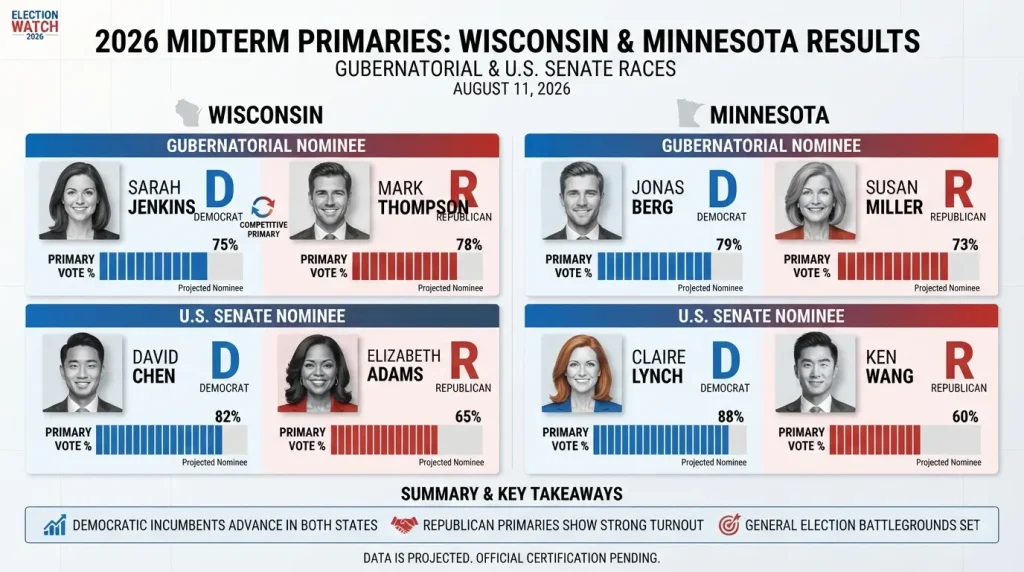
One of Wisconsin’s most closely watched contests was the Democratic gubernatorial primary. Milwaukee County Executive David Crowley defeated progressive state Rep. Francesca Hong, setting up a November matchup with Republican Tom Tiffany.
The result is significant because Hong sought to make history as the country’s first democratic socialist governor. Her defeat suggests that progressive candidates may still face limits in a competitive Midwestern swing state, particularly when opponents can consolidate moderate and establishment Democratic voters.
Wisconsin Watch’s pre-primary analysis also highlighted the importance of legislative races, where Democrats are seeking to regain control of both chambers.
Minnesota Democrats Choose a More Progressive Senate Candidate
Minnesota produced a different Democratic story. Lt. Gov. Peggy Flanagan defeated U.S. Rep. Angie Craig in the Democratic primary for the open U.S. Senate seat being vacated by Tina Smith.
Flanagan’s victory gives Minnesota Democrats a nominee who campaigned on a more forceful response to the Trump administration. Immigration policy became a particularly important issue during the primary, with Craig facing criticism over her previous vote for the Laken Riley Act.
The Minnesota Secretary of State’s election-results system provides the official statewide results, which remain unofficial until certification.
A Setback for Trump’s Influence in Minnesota
The Republican Minnesota gubernatorial primary delivered another noteworthy result. Lisa Demuth defeated Mike Lindell, the businessman and outspoken Trump ally who sought the Republican nomination.
Lindell’s defeat demonstrates that Trump’s endorsement and alignment with his political movement do not guarantee victory in every Republican primary. Demuth now advances to the general election, where Minnesota Republicans will attempt to compete for the governorship in a state that has become an important Democratic stronghold in recent presidential cycles.
Why These Results Matter Beyond November
The two states offer different lessons. Wisconsin Democrats rejected a more progressive gubernatorial candidate in favor of Crowley, while Minnesota Democrats selected Flanagan over a more centrist alternative.
That contrast makes it difficult to describe the 2026 primary electorate with a single ideological label. Instead, voters appear to be weighing candidate experience, electability, political identity and dissatisfaction with the status quo differently from state to state.
The results also underline the importance of candidate recruitment. In Wisconsin, Democrats are targeting both chambers of the state Legislature. According to Wisconsin Watch, Democrats need to flip two competitive Senate seats to win a majority and five Assembly seats to take control of that chamber.
The November Battle Is Only Beginning
Primary victories do not guarantee general-election success. Candidates must now broaden their coalitions, appeal to independents and prepare for the significantly larger November electorate.
Wisconsin is expected to remain one of the country’s most competitive political battlegrounds, while Minnesota’s open Senate race and gubernatorial contest could provide Republicans with an opportunity to expand their reach.
The Wisconsin and Minnesota primaries show that the 2026 midterms will not simply be a referendum on national party labels. Candidate ideology, electability, turnout and local issues will all matter. With the November 3 general election approaching, both states are positioned to become important tests of how voters are responding to the political environment.
#Wisconsin #Minnesota #Midterms2026 #Election2026 #Politics #USPolitics #MidtermElections