

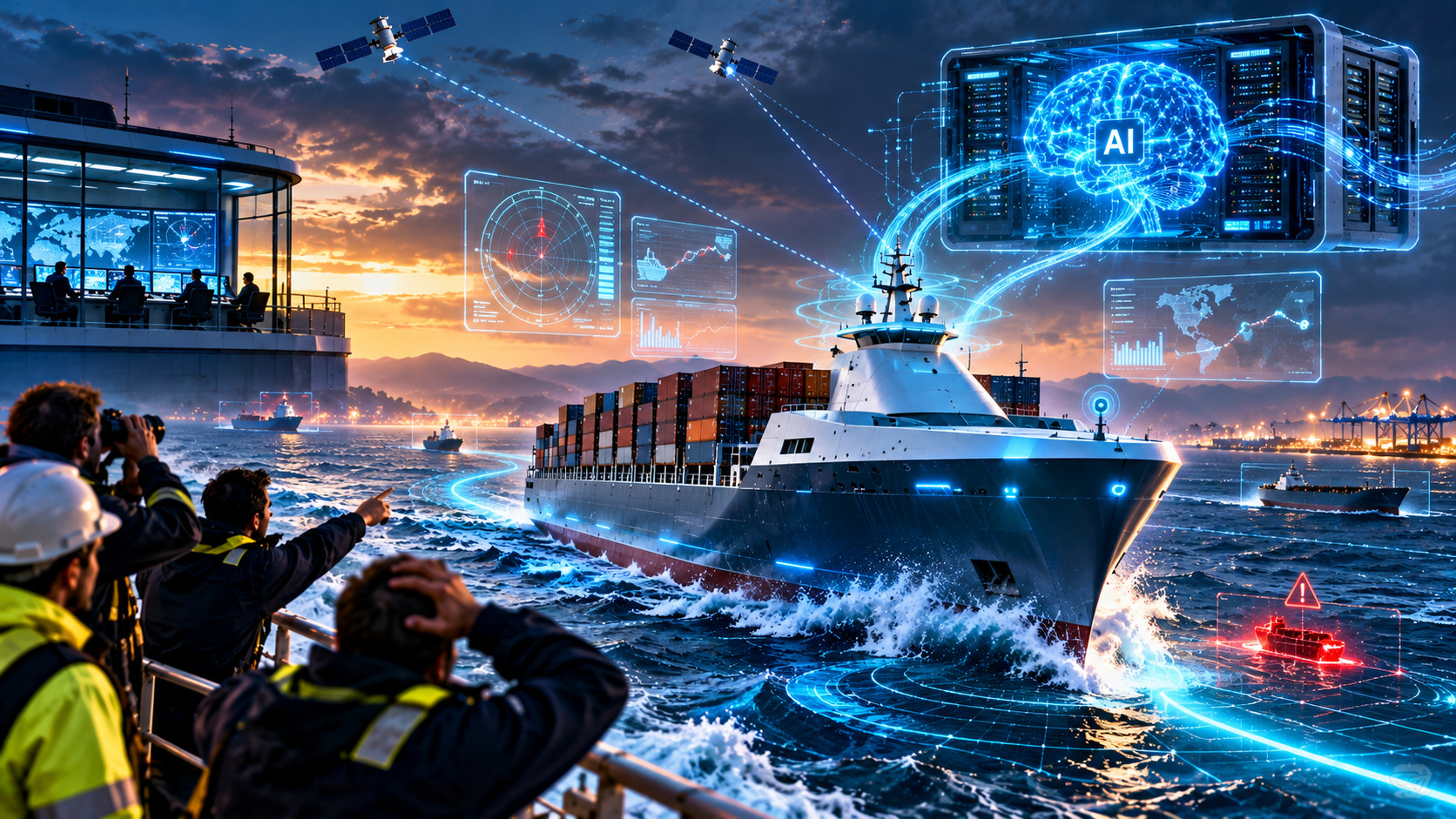
Autonomous ships could reshape global shipping by changing how vessels navigate, monitor risks, and manage onboard operations. But the transition to crewless international cargo shipping remains a complex challenge involving safety, regulation, cybersecurity, and commercial costs.
Advances in artificial intelligence, maritime sensors, satellite communications, and remote-control technology are making increasingly autonomous vessels possible. However, the benefits often associated with these ships—including lower costs, fewer accidents, and reduced emissions—are not guaranteed.
The central question is no longer simply whether autonomous ships can navigate. It is whether they can operate reliably, economically, and safely across the world’s busiest shipping routes.
What Are Autonomous Ships?
Autonomous ships are vessels capable of performing some navigation or operational functions with reduced direct human involvement.
They are also referred to as Maritime Autonomous Surface Ships, or MASS.
Not every autonomous vessel is completely unmanned. Different systems allow different levels of human involvement, from onboard crews supervising automated functions to remote operators controlling vessels from shore.
A fully autonomous ship would be capable of making operational decisions without continuous human intervention within its intended operating conditions.
That distinction matters because an experimental autonomous vessel operating in controlled waters is not equivalent to a large commercial cargo ship crossing international oceans without a crew.
How Do Autonomous Ships Work?
Autonomous navigation depends on several interconnected technologies.
Artificial intelligence and decision-support software: These systems process information, identify potential hazards, and assist with navigation decisions.
Radar, cameras, and other sensors: Sensor systems help detect nearby vessels, obstacles, and changing environmental conditions.
Satellite positioning and electronic charts: These technologies support navigation and route monitoring.
Remote operation centres: Human operators may supervise vessels, respond to emergencies, or assume control when necessary.
Communication systems: Reliable connectivity is important for monitoring, remote control, and exchanging operational information.
Combining these systems can reduce the need for certain manual tasks, but technological sophistication alone does not establish that a ship is safer than a conventionally operated vessel.
Are Autonomous Ships Already Operating?
Autonomous maritime technology has progressed beyond theoretical research.
One widely discussed example is Yara Birkeland, an electric container vessel developed for operations in Norway. The project demonstrates how automated navigation, electric propulsion, and specialized logistics infrastructure can be combined in a short-sea shipping application.
However, the vessel’s operating model should not be treated as proof that fully autonomous ocean-going cargo shipping has become routine.
Commercial deployment depends on the operating environment, regulatory approval, vessel design, safety systems, and availability of human oversight.
Short, predictable routes are generally more manageable test environments than busy international shipping corridors.
Could Autonomous Ships Reduce Shipping Costs?
Lower operating costs are among the potential attractions of autonomous shipping.
A vessel designed to operate with fewer people onboard might reduce some expenses associated with crew accommodation, provisions, and personnel.
Different vessel designs could also create opportunities to use onboard space differently.
However, those potential savings must be weighed against additional costs.
Autonomous vessels may require sophisticated sensors, redundant systems, software maintenance, remote-operation facilities, cybersecurity protection, specialist technicians, and additional regulatory compliance.
Remote operations can also create new staffing requirements rather than eliminate human involvement entirely.
Conventional commercial ships already operate continuously during voyages, using crews working in shifts. Autonomous systems therefore do not automatically create a 24-hour operating advantage.
The commercial case depends on whether total lifecycle costs fall after all investments, operating expenses, and risks are considered.
Can Autonomous Ships Improve Maritime Safety?
Autonomous navigation systems may help reduce certain risks associated with fatigue, poor situational awareness, or inconsistent human decisions.
They can process sensor information continuously and potentially alert operators to developing hazards.
However, autonomous vessels introduce different safety challenges.
Sensors can be affected by environmental conditions. Software may encounter situations outside its expected operating parameters. Communications can fail, and automated decision-making systems must interact safely with conventional ships.
Cybersecurity is another important concern because navigation, monitoring, and remote-control systems can become targets for malicious interference.
Human error is an important factor in maritime accidents, but removing crew members does not automatically remove the possibility of accidents.
Any claim that autonomous ships are safer overall requires reliable evidence from comparable operating conditions.
Are Autonomous Ships Better for the Environment?
Autonomous navigation may support environmental improvements through more efficient route planning, speed management, and operational coordination.
For example, optimizing a vessel’s speed and voyage planning could help reduce unnecessary fuel consumption under suitable conditions.
Nevertheless, autonomy and clean propulsion are different technologies.
An autonomous ship powered by conventional fuel is not automatically environmentally friendly.
Likewise, a conventional ship using low-emission propulsion can achieve environmental benefits without autonomous navigation.
The environmental performance of a vessel depends on factors including its energy source, design, operating speed, cargo capacity, and lifecycle emissions.
Projects that combine electric propulsion with autonomous technology may deliver benefits, but those benefits should not be attributed to autonomy alone.
The Regulatory Challenge: What Changed in 2026?
Regulation is one of the most important factors determining the future of autonomous commercial shipping.
The International Maritime Organization (IMO) has been developing a regulatory framework for Maritime Autonomous Surface Ships.
In May 2026, the IMO adopted its first non-mandatory MASS Code, with the framework taking effect in July 2026.
The code represents an important step toward international standards for autonomous vessel safety.
The IMO’s roadmap anticipates further work toward a mandatory framework, including planned adoption in 2030 and entry into force in 2032.
These dates represent regulatory objectives rather than guarantees that fully autonomous cargo vessels will be widely deployed by then.
Shipping companies must also address how existing maritime rules apply to remote operators, collision avoidance, emergency response, and responsibilities traditionally assigned to masters and crews.
International shipping crosses multiple jurisdictions, making consistent standards especially important.
What Autonomous Shipping Means for Maritime Workers
Automation could change the responsibilities of seafarers, shore-based operators, engineers, and maritime logistics professionals.
Some onboard tasks may be reduced or redesigned.
At the same time, autonomous shipping may increase demand for expertise in software engineering, remote vessel supervision, sensor maintenance, cybersecurity, and maritime data systems.
The employment effects will depend on adoption rates, vessel types, regulations, and the extent to which automation supplements rather than replaces crews.
Training and workforce transition planning will therefore be important parts of implementation.
Why Ports and Shipping Infrastructure Matter
Autonomous ships cannot be considered in isolation from the wider logistics network.
Ports may need compatible communication systems, traffic-management procedures, remote-monitoring capabilities, and operational protocols.
Cargo handling, berthing, emergency assistance, and maintenance must also be coordinated with the vessel’s level of automation.
This means that widespread autonomous shipping could require investment beyond the ships themselves.
When Could Fully Autonomous Cargo Ships Become Common?
There is no reliable single date for widespread adoption.
Autonomous functions are likely to develop at different speeds across different maritime applications.
Vessels operating on predictable routes, in controlled environments, or within specialized logistics networks may be easier to automate than large cargo ships navigating complex international routes.
Broader adoption will depend on demonstrated safety, commercially viable operating models, cybersecurity resilience, infrastructure readiness, insurance arrangements, and regulatory acceptance.
The development of international standards is a necessary step, but it is not sufficient on its own.
What Autonomous Shipping Could Mean for Global Trade
The long-term significance of autonomous shipping lies in its potential to change how vessels and logistics networks are managed.
More advanced navigation and monitoring could support better operational planning, while remote supervision might create new vessel operating models.
But the economic benefits will vary. Savings achieved by ship operators would not necessarily translate directly into lower freight rates or consumer prices.
Shipping rates are influenced by fuel costs, vessel supply, cargo demand, port congestion, geopolitical events, and other market conditions.
Autonomous shipping should therefore be viewed as a developing capability with significant possibilities rather than a guaranteed solution to the industry’s challenges.
Key Takeaways
- Autonomous ships use navigation software, sensors, communications, and varying degrees of human oversight.
- Real-world projects demonstrate progress, but fully autonomous international cargo shipping is not yet routine.
- Potential cost savings must be balanced against technology, infrastructure, staffing, and maintenance expenses.
- Safety improvements remain a possibility that must be demonstrated under real operating conditions.
- Autonomous navigation does not automatically reduce greenhouse gas emissions.
- The IMO’s 2026 MASS Code marks an important regulatory development, while broader implementation remains a longer-term process.
Conclusion
Autonomous ships could become an important part of the future maritime industry, but their impact will depend on much more than advances in artificial intelligence.
The real test will be whether autonomous systems can operate safely, comply with international rules, withstand technical failures, and deliver measurable economic and environmental benefits.
Rather than replacing the global shipping fleet overnight, maritime autonomy is more likely to develop through specialized applications, supervised operations, and gradual expansion as the technology and regulatory framework mature.
The future of shipping may involve fewer people physically onboard some vessels, but human expertise, oversight, and accountability will remain central to making that future work.
Sources and further reading
- International Maritime Organization — Autonomous Shipping: https://www.imo.org/en/MediaCentre/HotTopics/Pages/Autonomous-shipping.aspx
- International Maritime Organization — 2023 IMO Strategy on Reduction of GHG Emissions from Ships: https://www.imo.org/en/OurWork/Environment/Pages/2023-IMO-Strategy-on-Reduction-of-GHG-Emissions-from-Ships.aspx
- Yara International — Corporate information and Yara Birkeland project: https://www.yara.com/
- International Association of Marine Aids to Navigation and Lighthouse Authorities — Maritime Autonomous Surface Ships: https://www.iala.int/technical/mass/