

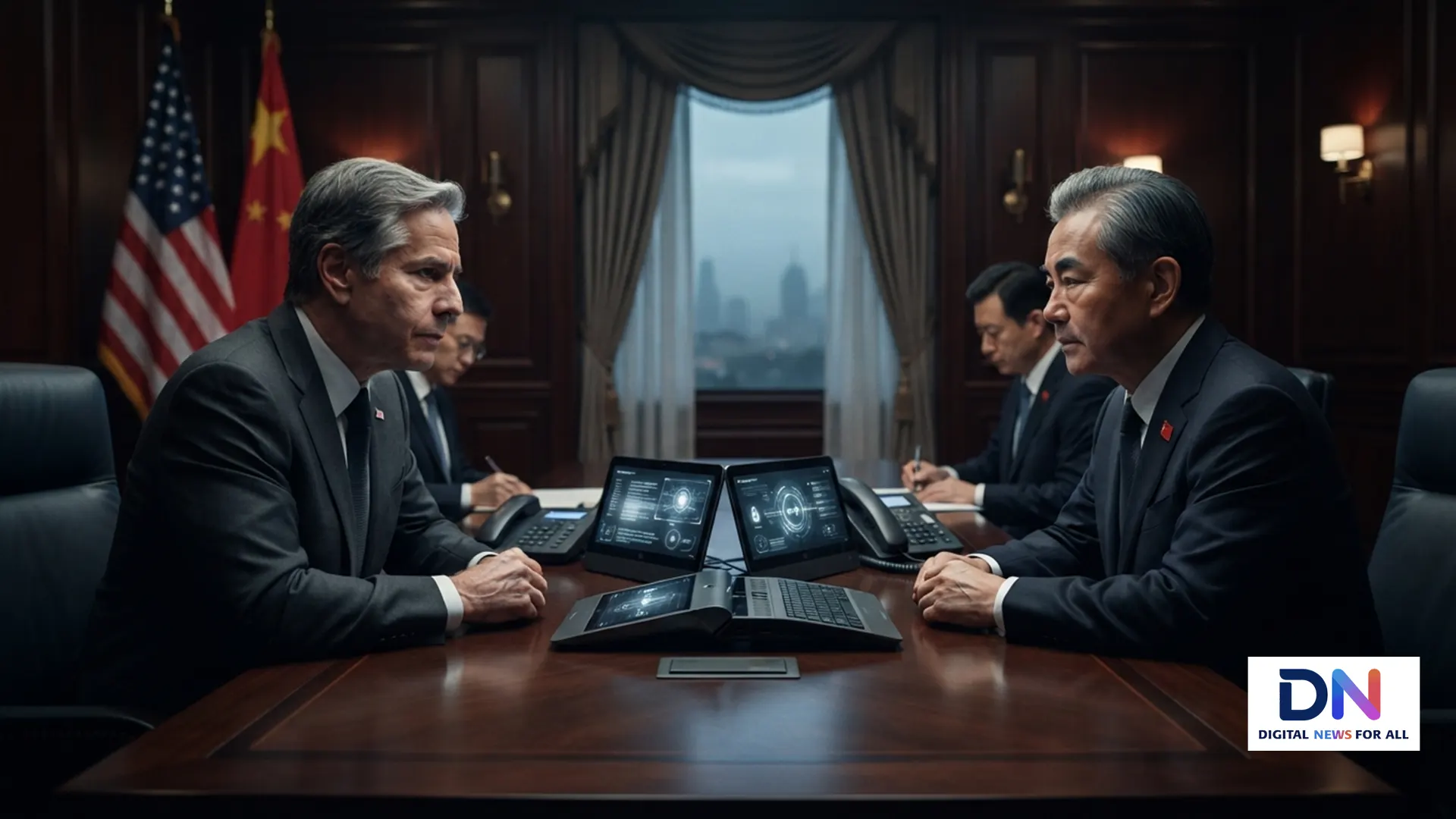
The proposed US-China AI hotline could create a new channel for communication between the world’s two leading AI powers. Washington and Beijing are discussing a mechanism that would allow each side to notify the other about artificial intelligence incidents serious enough to raise national-security concerns. The idea arrives as competition over chips, AI models and technological leadership intensifies.
What Is the Proposed AI Hotline?
The proposal emerged from talks in New York between U.S. Treasury Secretary Scott Bessent and Chinese Vice Premier He Lifeng ahead of President Donald Trump’s planned meeting with Chinese President Xi Jinping.
Bessent described the proposal as a notification mechanism within a broader U.S.-China AI dialogue. The objective would be greater transparency around potentially dangerous AI incidents and shared risks. The U.S. Treasury Department has been involved in the broader economic and diplomatic discussions.
The Associated Press reported that the precise circumstances that would trigger a notification have not yet been publicly defined. China has acknowledged discussions involving AI but has not publicly confirmed acceptance of the proposed mechanism.
Why AI Crisis Communication Matters
Artificial intelligence is increasingly connected to cybersecurity, financial systems, critical infrastructure and military applications. A serious AI incident could therefore cross national borders quickly.
Reuters recently reported that U.S. and Chinese security experts have discussed safeguards for AI systems used in military contexts. Their proposals include maintaining meaningful human control over critical operations and establishing communication channels for dangerous incidents.
A direct communication mechanism could theoretically reduce the risk that an unexpected AI event is misunderstood as a deliberate attack. That would be particularly relevant if autonomous systems become involved in cyber operations or other sensitive infrastructure.

The Technology Rivalry Has Not Disappeared
Diplomatic communication does not mean Washington and Beijing have resolved their technology disputes.
The two countries remain competitors in advanced semiconductors, AI computing and frontier models. WIRED reports that the proposed AI mechanism does not currently resolve disagreements over U.S. restrictions on advanced AI-related technologies.
The U.S. Bureau of Industry and Security continues to administer export controls affecting advanced computing and semiconductor technologies. Those controls remain a major source of tension in the broader U.S.-China technology relationship.
Could Transparency Become a Security Risk?
A hotline also creates difficult questions about what information should actually be shared.
National-security officials could be reluctant to disclose details about vulnerabilities, military AI systems or cyber capabilities. Even limited technical information might reveal how a country detects threats or where its defenses are weakest.
Al Jazeera reported that the exact triggers and scope of the proposed notification system remain unclear. That uncertainty means the initiative is better understood as an emerging diplomatic framework than a fully operational hotline.
Competition and Cooperation Can Coexist
The proposed US-China AI hotline reflects a difficult reality. Washington and Beijing can compete aggressively while still having reasons to communicate about risks that neither government can easily contain alone.
The Carnegie Endowment for International Peace has highlighted the potential for limited cooperation between the two countries even as their strategic competition continues. AI safety could become one of the areas where crisis communication is possible without requiring either side to abandon its broader technology policies.
What Happens Next?
The upcoming Trump-Xi discussions could determine whether the proposed mechanism develops into a permanent bilateral channel. Governments must still resolve important details, including which incidents qualify, who receives alerts, how quickly they respond, and what information they can safely share.
The concept therefore carries two possibilities at once. A reliable communication channel could reduce the danger of miscalculation during a rapidly developing AI crisis. Poorly defined information-sharing rules, however, could create security concerns of their own.
The coming negotiations will show whether Washington and Beijing can separate AI risk management from their broader technology rivalry. For now, the proposed hotline is an experiment in crisis diplomacy whose effectiveness will depend largely on trust, clear rules and verifiable boundaries.
#USChina #AIHotline #ArtificialIntelligence #AIDiplomacy #TrumpXi #AI安全 #TechNews #NationalSecurity