

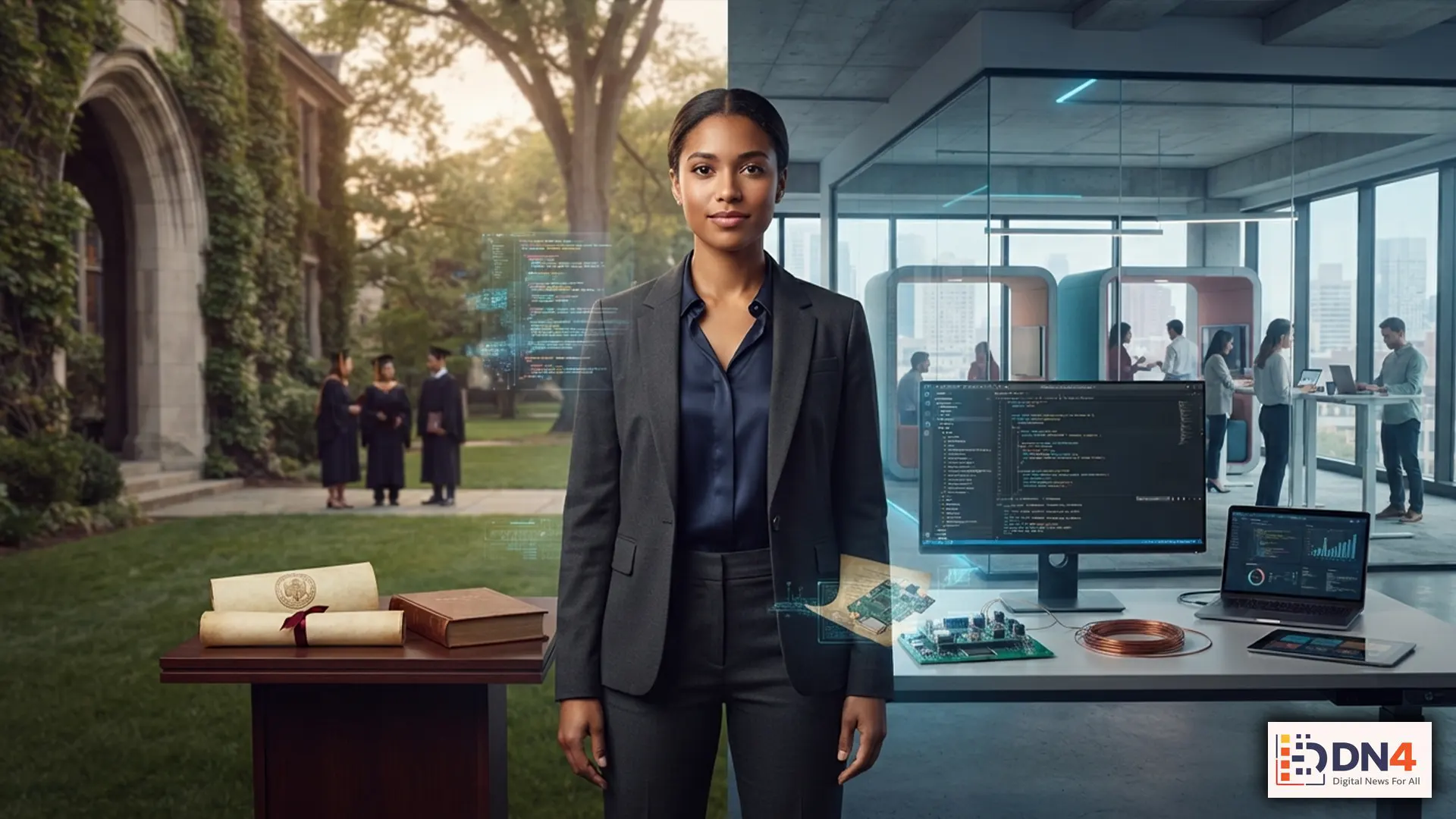
The college degree is not disappearing, but its role as a universal signal of employability is changing. Employers increasingly want evidence that candidates can solve problems, use modern technologies, communicate effectively and adapt to rapidly changing workplaces. That shift is putting new pressure on universities to connect academic learning with practical skills.
The Problem With the Degree as a Hiring Shortcut
For decades, a degree offered employers a convenient screening mechanism. It suggested that a candidate had completed a demanding course of study and developed persistence, communication and analytical abilities.
But research from Harvard Business School and the Burning Glass Institute shows why that shortcut is increasingly being questioned. Between 2014 and 2023, the number of roles where employers removed degree requirements increased almost fourfold. Yet the researchers found that actual hiring changes have been much smaller than the headlines suggest.
Employers Want Proof of Capability
The modern workplace changes faster than many traditional curricula. Artificial intelligence, cybersecurity, data analytics and digital collaboration tools are reshaping job requirements across industries.
The World Economic Forum’s Future of Jobs Report 2025 identifies analytical thinking as a leading core skill. AI and big data, networks and cybersecurity, technological literacy, creative thinking and adaptability are also among the skills expected to become increasingly important through 2030.
This creates a difficult question for universities: Is completing a curriculum enough if graduates cannot demonstrate how their knowledge applies to real workplace problems?

Experience Is Becoming a Stronger Signal
Employers are increasingly looking at portfolios, internships, apprenticeships, certifications, work samples and skills assessments alongside—or sometimes instead of—traditional academic credentials.
According to the World Economic Forum, 81% of surveyed employers expect to continue using work experience as a skills-assessment mechanism through 2030, while 48% expect to use skills assessments. University degrees remain important, but their expected use as a requirement is lower at 43%.
India Is Part of the Same Shift
The trend is particularly relevant in India, where employers are preparing for rapid technological transformation. The World Economic Forum reports that 30% of companies operating in India expect removing degree requirements in favor of skills-based hiring to be an effective approach to expanding talent availability.
That does not mean degrees have become irrelevant. Engineering, medicine, law, research and many regulated professions still require formal qualifications. Instead, the change is concentrated in occupations where demonstrable competence can be assessed directly.

Universities Need to Close the Skills Gap
The challenge is therefore not simply “degrees versus skills.” The strongest education model may combine both.
Universities can strengthen their value by embedding internships, industry projects, simulations, portfolio development, AI literacy and employer-recognized certifications into academic programs. Students can also supplement formal education with practical projects that demonstrate what they can actually build, analyze or improve.
The Degree Is Changing, Not Disappearing
Research from Burning Glass Institute shows an important reality: removing degree requirements from job advertisements does not automatically produce skills-based hiring. Employers must also change screening systems, interview practices and internal promotion pathways.
The future therefore belongs neither exclusively to universities nor exclusively to short-term credentials. It belongs to a more transparent labor market where education provides a foundation and demonstrable skills provide evidence of what a worker can do.
The question employers increasingly ask is no longer simply, “What degree do you have?” It is becoming, “What can you actually do?”
#SkillsBasedHiring #FutureOfWork #Education #CareerDevelopment #Employability #HigherEducation #Workforce #Hiring #CareerAdvice