

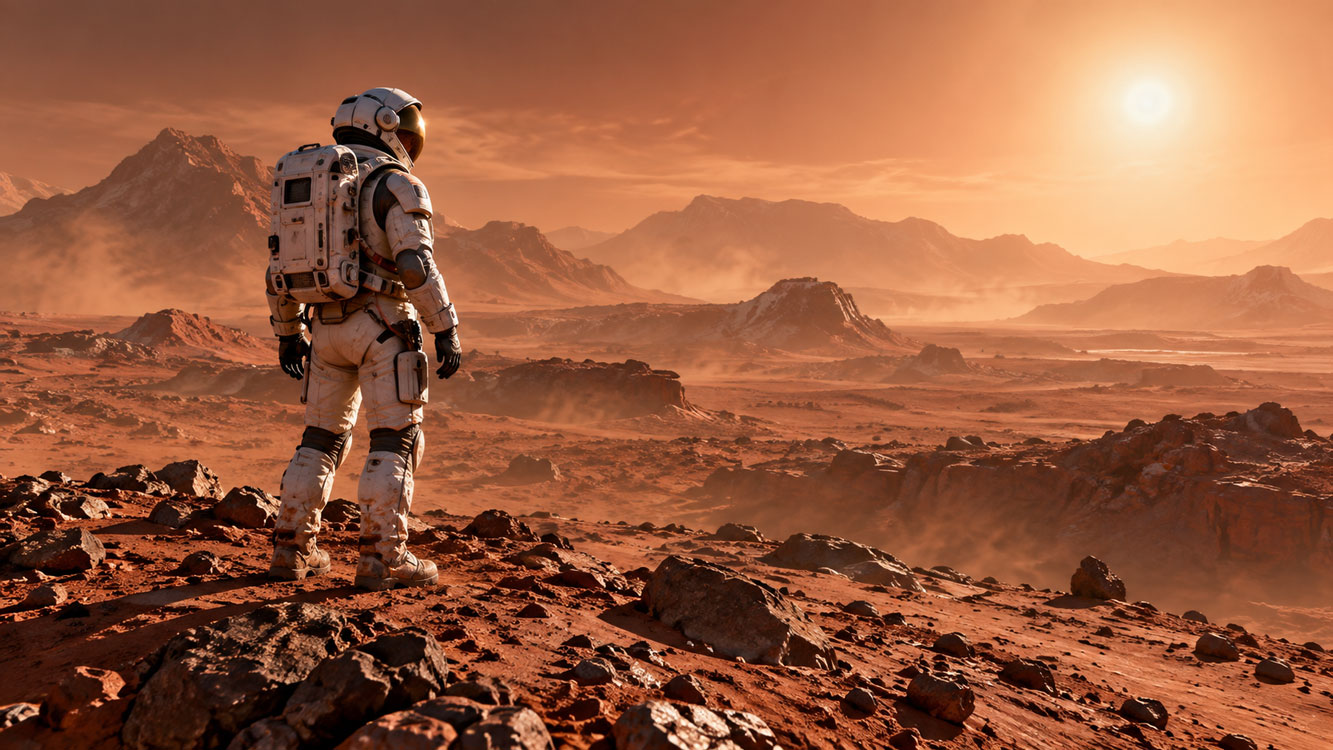
Could humans walk on Mars without space suits? With current human biology, the answer is no.
The most immediate problems would not be Martian dust, radiation or even the planet’s famous cold. They would be the almost complete absence of breathable oxygen and the extremely low atmospheric pressure. An unprotected person on the Martian surface would rapidly face a life-threatening emergency.
That makes a Mars space suit far more than warm clothing. It would essentially be a wearable life-support system, supplying oxygen, maintaining safe pressure, controlling temperature and helping protect its wearer from the surrounding environment.
Watch the video: Could You Survive on Mars Without a Space Suit? here https://youtu.be/97orb_o20As
You Could Not Breathe the Martian Atmosphere
Mars has an atmosphere, but it bears little resemblance to the air humans breathe on Earth.
Measurements from NASA’s Curiosity rover at Gale Crater found an atmosphere containing about 95% carbon dioxide, 2.6% molecular nitrogen, 1.9% argon and only around 0.16% molecular oxygen.
That tiny oxygen concentration is nowhere near enough for humans to breathe.
There is another major problem: atmospheric pressure.
NASA’s Jet Propulsion Laboratory describes Mars as having surface atmospheric pressure less than one-hundredth of the average pressure at Earth’s surface. So even if a person somehow had access to oxygen, simply exposing the human body to the Martian atmosphere would still be extremely dangerous.
NASA’s human-spaceflight standards identify pressure suits as protection against hazards associated with loss of atmospheric pressure, including hypoxia, decompression sickness and ebullism. NASA’s spacesuit standards therefore make clear why maintaining pressure is as important as supplying breathable oxygen.
In other words, bringing an oxygen mask to Mars would not solve the problem. A human would need both breathable gas and a pressurized environment.
Mars Is Extremely Cold — But Temperature Is Not the Only Immediate Threat
Mars has a reputation for being frozen, and with good reason.
According to NASA’s Jet Propulsion Laboratory, the planet has an average surface temperature of roughly -64°F (-53°C), although temperatures vary considerably depending on location, season and time of day. Temperatures can fall below -190°F (-120°C) during polar night, while some equatorial locations can become considerably warmer during daytime.
Those conditions create serious thermal-control problems for human explorers.
However, it is misleading to imagine that freezing would necessarily be the first thing to kill an astronaut whose suit suddenly failed. The combination of extremely low atmospheric pressure and lack of breathable oxygen creates a more immediate emergency.
A Mars suit therefore has to solve several problems simultaneously: pressure, oxygen supply, carbon-dioxide removal, temperature control and environmental protection.
What Would Low Pressure Do to the Human Body?
One of the strangest dangers on Mars is invisible.
Because atmospheric pressure is so low, the human body cannot function as it does at Earth’s surface. NASA identifies ebullism among the hazards that pressure suits must protect astronauts against during atmospheric pressure loss.
Ebullism occurs when sufficiently low pressure allows water in body tissues to begin forming vapor bubbles. That does not mean a person would instantly explode, as some science-fiction scenes suggest, but exposure would still constitute a life-threatening decompression emergency.
This is one reason future Mars explorers will require pressurized suits whenever they leave a protected habitat.
Radiation Is a Serious Mars Problem — But Not Quite in the Way Movies Suggest
Mars also exposes explorers to a radiation environment very different from Earth’s.
Earth benefits from a thick atmosphere and a global magnetic field. Mars has a much thinner atmosphere and lacks a comparable global magnetic shield, leaving its surface more exposed to energetic particles from space.
NASA’s Curiosity rover carries a Radiation Assessment Detector, or RAD, specifically to measure the energetic radiation environment and help scientists understand the risks future human explorers could face.
Radiation is therefore a major challenge for long-duration human exploration.
But it should not be confused with the immediate danger caused by losing a pressure suit. For a person suddenly exposed on Mars, oxygen deprivation and extremely low pressure would become emergencies much sooner. Radiation becomes particularly important when considering the accumulated exposure of astronauts traveling to, living on and working on Mars.
Habitats, vehicles and suits will therefore need to form part of a broader radiation-protection strategy for future crews.
What About Martian Dust Storms?
Mars really does experience enormous dust storms, including regional events and storms that can sometimes spread across much of the planet.
But Hollywood can make them look more physically violent than they really are.
Because the Martian atmosphere is extremely thin, winds do not exert the same force as equivalent-speed winds in Earth’s much denser atmosphere. NASA’s comparison of dust storms on Mars and Earth helps explain why a dramatic storm effortlessly throwing astronauts and heavy spacecraft across the surface is not an accurate representation of Martian conditions.
Dust remains a serious engineering and potential health concern for different reasons.
Fine particles can remain suspended, obscure the atmosphere, interfere with equipment and reduce sunlight reaching solar-powered systems. NASA is also studying potential health risks from Martian dust because particles brought into crew habitats could create respiratory and other exposure concerns. In 2026, NASA described ongoing work to establish crew exposure limits for Martian dust ahead of future human missions.
So the danger is real — just different from the movie version.
Would Mars’ Low Gravity Be Dangerous?
Gravity on Mars is only about 38% of Earth’s.
That would fundamentally change how astronauts move and work, but it is not a reason someone would need a pressure suit for a short trip outside.
The larger question is what months or years in partial gravity would do to the human body.
Human spaceflight has provided extensive information about the effects of microgravity, but Mars presents a different environment: it has substantial gravity, just much less than Earth. The long-term physiological consequences of living continuously under Martian gravity remain an important question for future human exploration.
It is therefore more accurate to treat partial gravity as a long-duration human-health and mission-design question rather than one of the immediate causes of death during pressure-suit failure.
Could Astronauts Make Oxygen on Mars?
Here the story becomes considerably more optimistic.
NASA has already demonstrated technology capable of producing oxygen using the Martian atmosphere.
The Mars Oxygen In-Situ Resource Utilization Experiment, better known as MOXIE, traveled to Mars aboard NASA’s Perseverance rover. Instead of finding free oxygen for astronauts to breathe, the experiment took carbon dioxide from the Martian atmosphere and electrochemically extracted oxygen from it.
According to NASA, MOXIE operated 16 times and produced a total of 122 grams of oxygen during its demonstration. At its most efficient, the experiment produced 12 grams of oxygen per hour at 98% purity or better.
MOXIE was a technology demonstration, not a life-support plant capable of supplying astronauts. Any future operational system would need to work on a dramatically larger scale.
Its significance is nevertheless substantial: humans have already demonstrated on Mars that oxygen can be manufactured from local atmospheric resources.
That oxygen could eventually contribute not only to crew life-support systems but also to producing the large quantity of oxidizer required for a rocket carrying astronauts away from the Martian surface.
Why Astronauts Cannot Simply Call Earth for Immediate Help
Living on Mars creates another challenge that no space suit can solve: distance.
Depending on the relative positions of the two planets, a radio signal between Earth and Mars can take several minutes to travel in one direction. NASA describes one-way Earth-Mars communication delays ranging roughly from four to 24 minutes.
That means a Mars crew facing an emergency could not have a normal real-time conversation with mission control on Earth.
Astronauts and their systems would need far greater operational independence than crews working relatively close to Earth. Habitats, suits and vehicles would require redundancy, repair capability and emergency procedures designed for situations in which Earth cannot provide immediate assistance.
So, Could Humans Survive on Mars Without Space Suits?
Not on the open Martian surface with the human body as it exists today.
Mars has almost no breathable oxygen, atmospheric pressure is far below what humans require, temperatures can become extremely low, and the planet presents substantial radiation and dust hazards.
A future astronaut walking across Mars would therefore need much more than an oxygen tank. The astronaut would need a pressurized, thermally controlled life-support system capable of creating a tiny Earth-like environment around the body.
There is, however, an important distinction between saying humans cannot survive unprotected on Mars and saying humans can never live there.
Technology can change the equation.
MOXIE has already demonstrated that oxygen can be extracted from the Martian atmosphere. Robotic missions continue to study the planet’s climate, radiation environment, geology and resources. Engineers and scientists are investigating the systems future crews would need to live and work millions of kilometers from Earth.
The real challenge of human exploration of Mars is therefore not making the planet naturally safe for an unprotected person. It is learning how to build reliable artificial environments in which humans can survive.
Until that technology exists at mission scale, one conclusion is straightforward: stepping onto Mars without a pressure suit would be a life-threatening emergency, not the beginning of an afternoon walk.
Sources and Further Reading
- NASA — Curiosity measurements of gases in the Martian atmosphere
- NASA/JPL — Mars at a Glance
- NASA — Human Integration Design Handbook: Spacesuits
- NASA Science — Curiosity science instruments and radiation measurements
- NASA Earth Observatory — Dusty Differences Between Mars and Earth
- NASA — Establishing Crew Exposure Limits for Martian Dust
- NASA — MOXIE Completes Its Mars Mission
- NASA — Space Communications: Earth-Mars Signal Delays