


FinCEN BOI reporting has undergone a major change, giving many U.S. small-business owners relief from a federal compliance requirement that had created uncertainty for LLCs, corporations and other entities.
In March 2025, the Financial Crimes Enforcement Network revised the beneficial ownership information framework under the Corporate Transparency Act. Under the revised rule, entities created in the United States and their beneficial owners are exempt from federal BOI reporting.
What the New BOI Rules Mean for Small Businesses
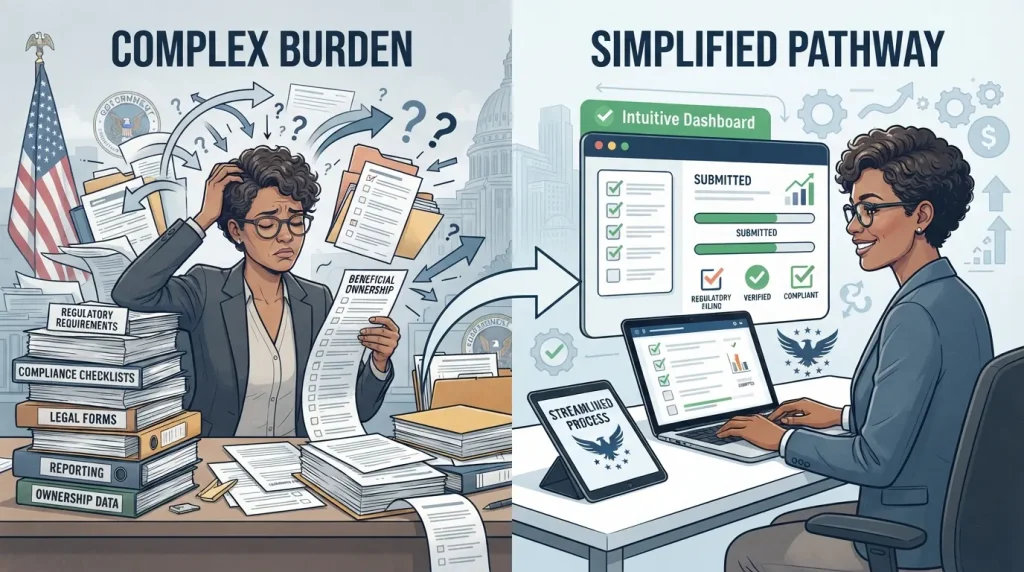
For a typical company formed under U.S. law, the most important takeaway is that it is no longer required to submit an initial BOI report to FinCEN under the current framework.
The agency’s Interim Final Rule Q&A explains that domestic companies are excluded from the revised definition of a reporting company. Consequently, U.S.-created businesses generally do not have an ongoing federal BOI filing, updating or correcting obligation under the revised rule.
This is particularly relevant to small-business owners who previously had to identify beneficial owners, collect required information and monitor filing deadlines.
Why FinCEN Changed the Reporting Framework
The original beneficial ownership reporting system was created through the Corporate Transparency Act, which sought to make it harder for criminals to hide ownership through anonymous corporate structures.
The reporting requirement subsequently became a major compliance issue for smaller companies. Business owners and professional advisers had to determine whether entities qualified as reporting companies and whether exemptions applied.
FinCEN’s revised approach substantially narrows the population required to report, reducing the federal administrative burden for domestic businesses.
Foreign Entities Are Still Different
Business owners should not interpret the change as a universal end to beneficial ownership reporting.
Certain companies formed under foreign law that register to conduct business in a U.S. state or tribal jurisdiction can still fall within the reporting-company definition. FinCEN’s BOI Quick Reference outlines the applicable reporting framework and deadlines for qualifying foreign entities.
Business owners should therefore establish whether their company was actually created in the United States or is a foreign entity registered to operate domestically before assuming that no BOI obligation applies.

What Should Small-Business Owners Do Now?
- Confirm where the business was legally formed.
- Review the latest FinCEN BOI guidance before filing anything.
- Check whether another exemption or reporting category applies.
- Continue complying with state and local business-registration requirements.
- Maintain accurate ownership and corporate records.
- Monitor future regulatory developments.
The U.S. Department of the Treasury has also published information about the revised framework. Meanwhile, the Small Business Administration provides separate guidance covering broader business-registration obligations.
Is BOI Reporting Permanently Over?
There is an important qualification to the word “permanent.” While the revised framework removes the federal BOI reporting requirement for U.S.-created companies, FinCEN describes the March 2025 measure as an interim final rule.
For that reason, businesses should treat the current exemption as the operative rule while continuing to monitor official FinCEN announcements rather than relying on outdated filing deadlines or third-party compliance notices.
Current rules have effectively removed the federal BOI reporting burden for U.S.-created small businesses. However, qualifying foreign entities can still have reporting responsibilities, and regulatory developments could affect the framework in the future.
#FinCEN #BOIReporting #SmallBusiness #CorporateTransparencyAct #BusinessNews #BusinessCompliance #Entrepreneurship #USBusiness #FinanceNews