

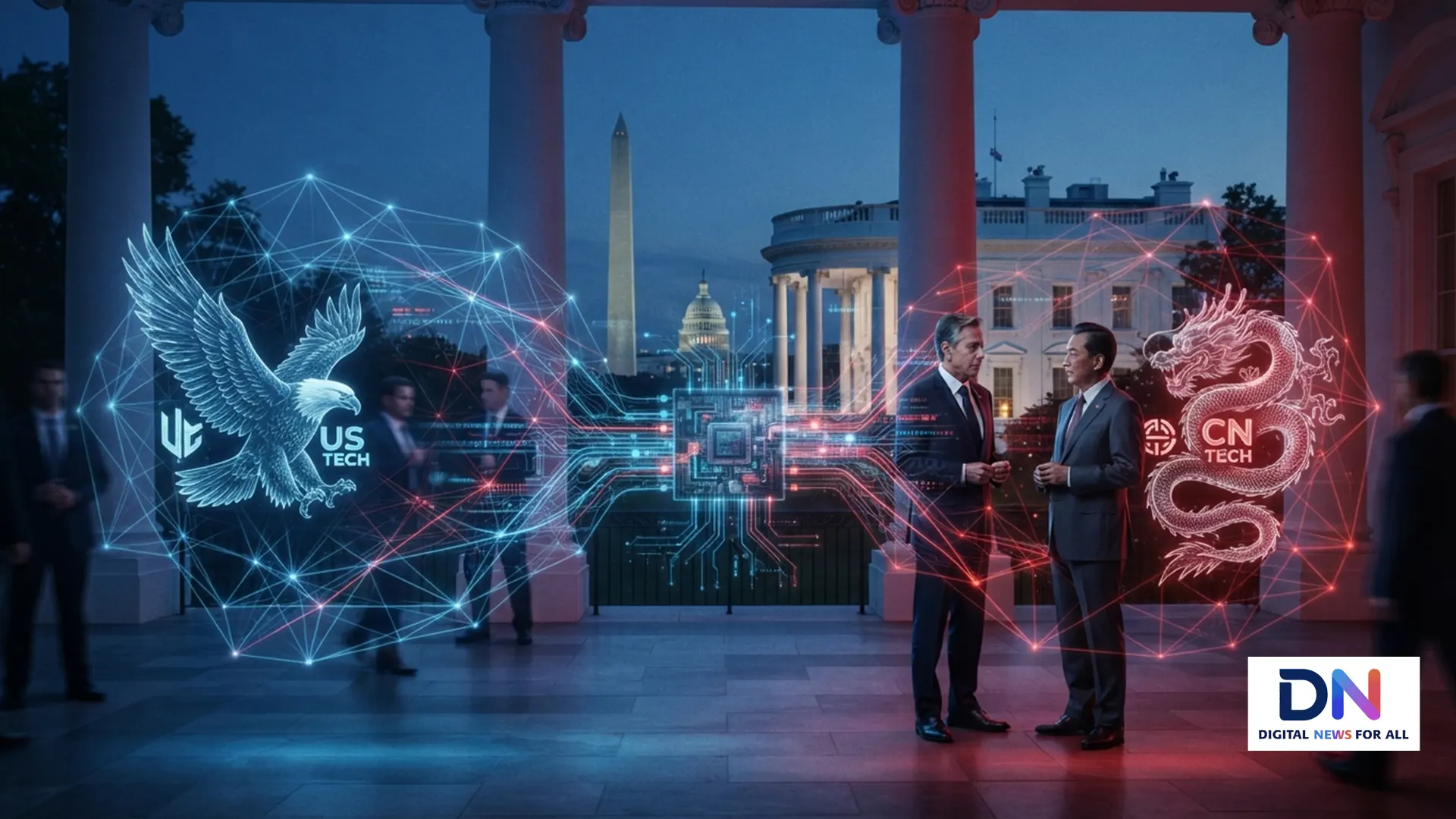
The US-China AI war is moving from Silicon Valley and Shenzhen into the White House. President Donald Trump is hosting Chinese President Xi Jinping in Washington on September 24, 2026, with technology, trade and artificial intelligence among the major issues surrounding the summit. The White House has confirmed Xi’s official state visit.
Why AI Has Become a Strategic Battleground
The competition extends well beyond chatbots. Advanced AI depends on powerful processors, semiconductor manufacturing, data centers, software and access to critical materials. Washington has used export controls to restrict China’s access to some advanced computing technologies.
The U.S. Bureau of Industry and Security revised its semiconductor licensing policy in January 2026, allowing certain Nvidia H200 and AMD MI325X exports to China to be reviewed case by case under specified security conditions.
That illustrates the complicated nature of the rivalry. The United States is trying to protect sensitive technology while also managing a technology industry that sells products globally.
What Could the Summit Mean for Consumer Tech?
Consumers may not notice a geopolitical agreement immediately. However, decisions involving chips, manufacturing equipment, rare-earth materials and tariffs can eventually affect smartphones, computers, electric vehicles and other connected products.
The International Energy Agency says highly concentrated critical-mineral supply chains remain vulnerable. China plays an important role in several processing and manufacturing stages, making supply-chain security relevant to the wider technology industry.
AI Safety Could Create a Different Kind of Cooperation
The summit is not only about competition. U.S. officials have proposed a mechanism for notifying each other about serious AI incidents involving national security.
Reuters reported that Washington and Beijing could expand dialogue on AI risks even while remaining competitors. Reuters’ latest summit report says both governments are expected to discuss AI alongside trade, technology and other contentious issues.
The Center for Strategic and International Studies says the September 24 meeting could become an important test of future AI governance discussions. Its analysis notes that disagreements remain over export controls, advanced models, open-weight systems and AI security.
The Chip Question Remains Critical
Semiconductor restrictions remain one of the clearest links between national-security policy and everyday technology. The Commerce Department has previously expanded controls covering advanced chips, semiconductor manufacturing equipment and high-bandwidth memory used in advanced computing.
BIS explains that these controls target technologies used in advanced computing and AI. Future policy decisions could therefore influence which chips companies can sell, where they manufacture them and how quickly new consumer devices receive AI capabilities.
What American Consumers Should Watch
The most important signals may come after the summit. Consumers should watch for changes involving semiconductor export rules, rare-earth supplies, tariffs, AI model access and technology investment.
The BIS export-control framework already contains detailed rules governing advanced computing items and certain U.S.-headquartered technology companies. Any future changes could reshape how global AI infrastructure is built.
The US-China AI war therefore reaches far beyond government laboratories. The rivalry could influence the price, availability and capabilities of the consumer technology Americans use every day. The Washington summit may not resolve that competition, but it could establish rules for how the two countries manage it.
#USChina #AI #AIWar #ArtificialIntelligence #ChinaTech #USATech #AIChips #Semiconductors #TrumpXi #WashingtonSummit #ConsumerTech #TechNews