

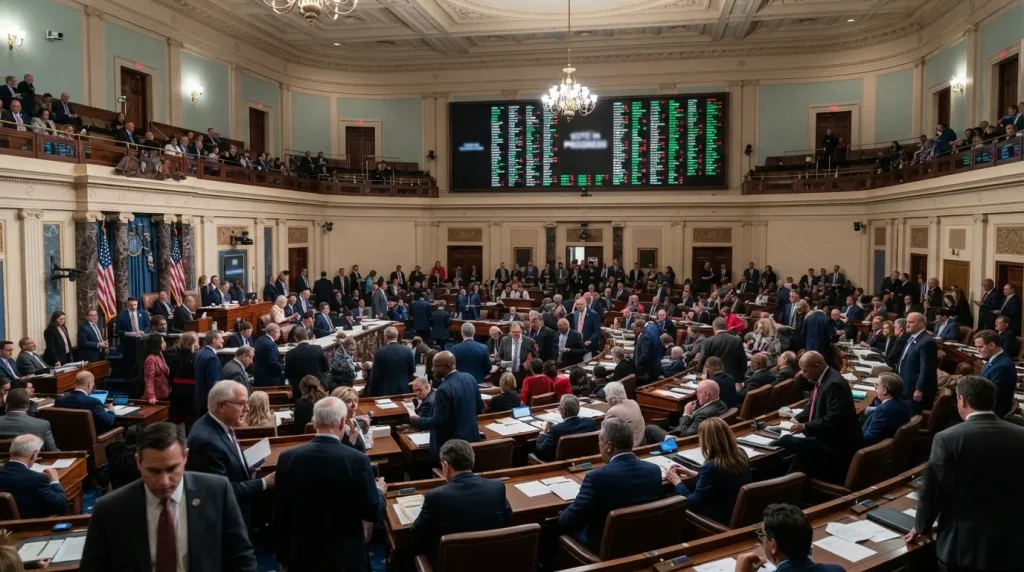
The War Powers Resolution is back at the center of Washington’s debate over presidential military authority. On September 15, 2026, the House passed another resolution directing President Donald Trump to remove U.S. forces from hostilities with Iran.
The vote was 220–204, with seven Republicans joining Democrats. It was the third House vote this year on a similar Iran war-powers measure. The House Clerk’s official roll call records the vote and the resolution’s language.
What the War Powers Resolution Does
Congress enacted the War Powers Resolution in 1973 following the Vietnam War. Its stated purpose is to ensure that both Congress and the president participate in decisions involving U.S. forces and hostilities.
Under the law, the president generally must notify Congress when U.S. forces enter hostilities or situations where involvement is clearly imminent. The statute also establishes a 60-day framework for unauthorized military action, subject to limited provisions concerning withdrawal.
The United States Code sets out the War Powers Resolution’s purpose and statutory framework.
Why Iran Has Created a Legal Dispute
The Trump administration and congressional critics have disagreed over how the law applies to the Iran conflict. Earlier in 2026, the administration argued that a ceasefire affected the operation of the War Powers clock.
The Brookings Institution has documented the competing legal interpretations surrounding the 60-day requirement and the administration’s position.
The White House has also formally opposed the latest House resolution. Its Statements of Administration Policy list H.Con.Res. 93 among the measures addressed by the administration.
House Action Does Not End the Conflict
The latest House vote does not itself end U.S. military operations. Previous attempts have also faced significant obstacles in the Senate and at the presidential level.
Reuters reported in July that the House and Senate had taken different positions on Iran war-powers resolutions. The Senate has previously rejected or failed to advance comparable measures despite bipartisan votes on some occasions.
The Senate Foreign Relations Committee’s legislative tracker shows the continuing stream of Iran-related war-powers measures moving through Congress.

A Constitutional Question Beyond Iran
The dispute reaches beyond one military operation. Article I of the Constitution gives Congress the power to declare war, while Article II makes the president commander in chief. The War Powers Resolution was designed to establish procedures between those two constitutional authorities.
That division has remained contested for decades. The Reuters account of the July congressional votes illustrates how the current dispute has produced different outcomes in the two chambers.
Meanwhile, lawmakers are continuing to introduce new measures. On September 16, Senators Tim Kaine and Adam Schiff filed a separate War Powers Resolution concerning possible U.S. hostilities involving Oman.
The Senate sponsors’ announcement describes the proposal and its connection to the broader debate over congressional authorization of military action.
What Happens Next?
The immediate question is whether the latest House action can advance through the Senate and produce a measure capable of changing U.S. military policy. The larger question is how Congress and the executive branch will define their respective roles when military operations continue without a formal declaration of war.
For lawmakers, the Iran conflict has therefore become both a foreign-policy dispute and a test of the institutional boundaries established by the Constitution and the War Powers Resolution.
#WarPowers | #Congress | #IranConflict | #PresidentialPower | #USPolitics | #Constitution | #2026Midterms