

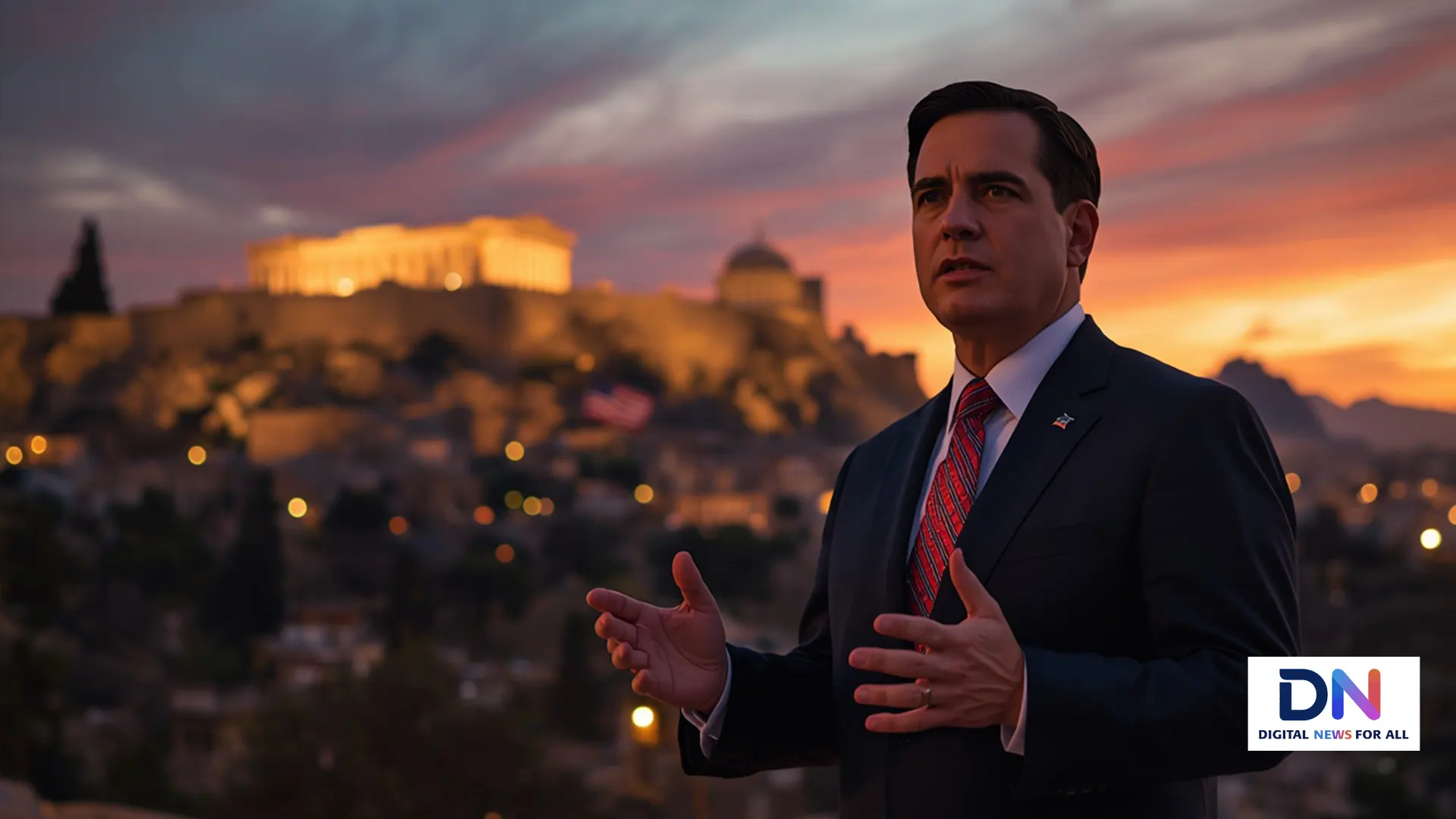
Rubio Greece speech in Athens has put history at the center of a modern foreign-policy argument. On October 7, 2026, Secretary of State Marco Rubio used the ancient Pnyx, overlooking the Acropolis, to connect classical Greek ideas with President Donald Trump’s “America First” approach.
Rubio argued that ancient Greece represented more than democracy and philosophy. He highlighted ambition, competition, courage, national loyalty, exploration and the willingness to defend national interests. Reuters reported that he presented these ideas as part of a broader argument for renewed Western confidence and national power. Reuters’ coverage of Rubio’s Athens speech provides the key context.
Why Ancient Greece Became the Centerpiece
Rubio’s argument rests on a long-established connection between classical Greece and Western political thought. Athens developed important forms of participatory government, while Greek philosophers including Plato and Aristotle profoundly influenced later political philosophy.
The United States has also historically invoked Greek and Roman examples. The Library of Congress documents classical influences on America’s founding era, including the use of classical imagery and political ideas.
Where the Historical Debate Begins
The controversy concerns how selectively this history is being presented. Ancient Greece was not a single unified nation-state, and Athens’ democracy excluded large parts of its population, including women, enslaved people and non-citizens.
Rubio’s speech emphasized heroic competition and civic loyalty while giving less attention to the conflicts, inequalities and rival political systems within the ancient Greek world. Critics therefore see the speech as an interpretation of antiquity designed to support a contemporary political worldview rather than as a complete account of Greek history.
America First Meets Western Civilization
The Rubio Greece speech also placed nationalism inside a larger Western narrative. Rubio argued that national loyalty is not inherently selfish and said states must be willing to defend their interests when diplomacy fails.
That position fits with the Trump administration’s broader emphasis on national power. CBS News’ report noted that Rubio connected ancient Greece with a historical chain extending through Rome, European Christianity and eventually the United States.
Vision, Political Messaging or Both?
The speech can therefore be read in several ways. Supporters of Rubio’s historical framing can see it as an argument for confidence, civic responsibility and Western strategic strength. Critics can question whether ancient societies are being simplified to validate modern nationalism.
Either way, the setting and message were significant. By placing America First alongside classical Greece, Rubio turned a foreign-policy address into a broader argument about history, identity and the future direction of the West.
Reuters, CBS News, Associated Press, Library of Congress, Encyclopaedia Britannica, U.S. Department of State, U.S. National Archives
#MarcoRubio #Rubio #AmericaFirst #Greece #AncientGreece #WesternCivilization #USForeignPolicy #Politics #ForeignPolicy #ClassicalGreece #TrumpAdministration