


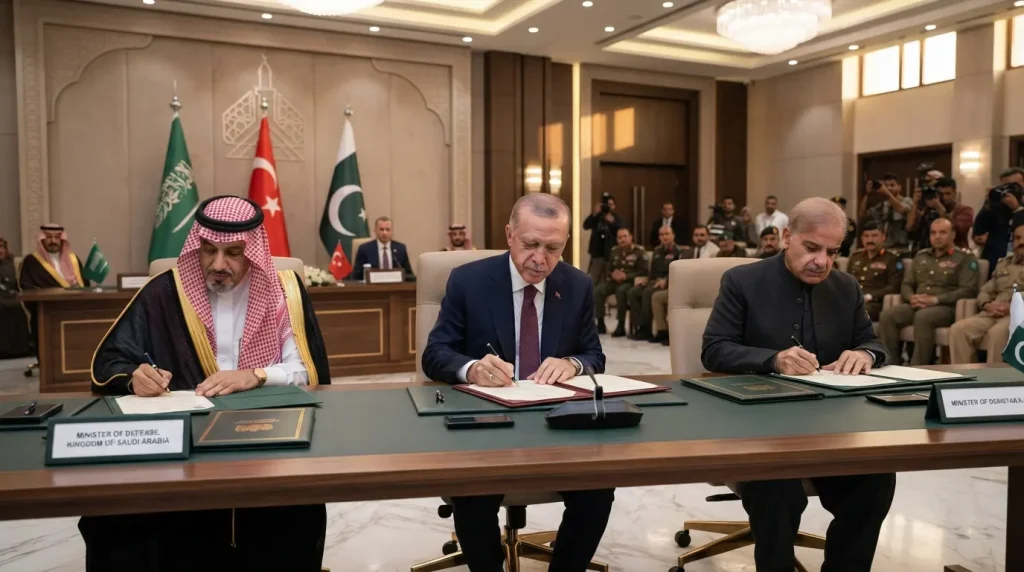
A new defense agreement between Saudi Arabia, Turkey and Pakistan is reshaping the strategic conversation across the Middle East. Signed in Mecca on August 7, 2026, the Mecca Joint Defence Agreement commits the three countries to treating an attack against one member as an attack against all. The agreement arrives amid intense regional instability and growing questions about the reliability of traditional security arrangements.
What the New Pact Actually Says
The agreement establishes a framework for closer military and strategic coordination among three influential Muslim-majority states. Reuters reports that the pact includes a collective-defense principle, although it does not contain the detailed military commitments associated with NATO’s Article 5.
Officials have emphasized that the agreement is defensive rather than an alliance directed against a particular country. Pakistan’s foreign minister also said the framework remains open to additional countries that meet its requirements. The Associated Press reports that the pact does not override the three countries’ existing bilateral or multilateral commitments.
Why Saudi Arabia Wants More Security Options
For Riyadh, the agreement represents another layer of strategic insurance. Saudi Arabia has relied heavily on American military capabilities and security partnerships for decades, but regional conflicts have encouraged Gulf governments to diversify their defense relationships.
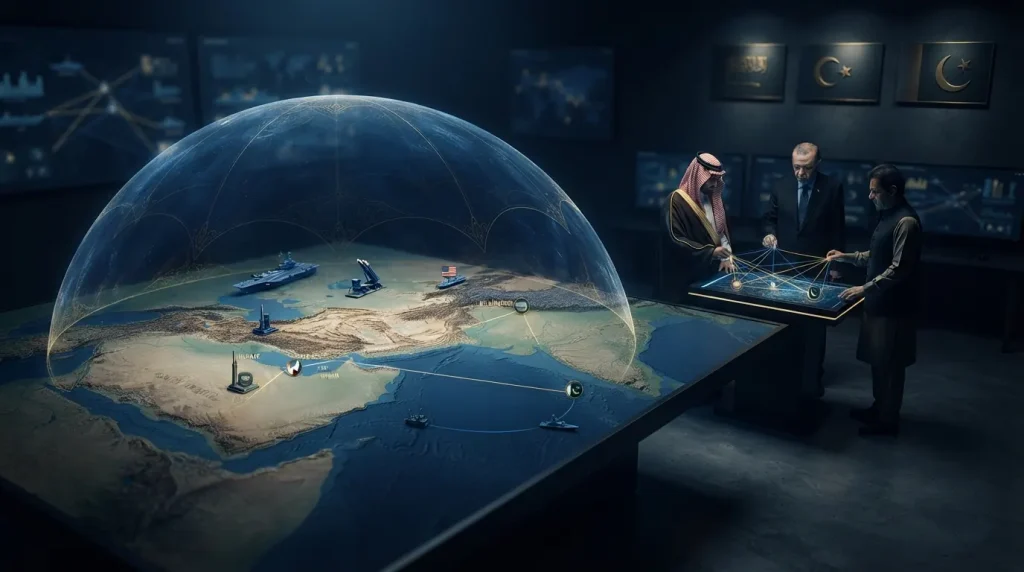
The Saudi-Pakistani relationship already had a formal foundation. The two countries signed their own Strategic Mutual Defence Agreement in September 2025. The new Mecca agreement expands that framework by bringing Turkey into a trilateral security structure. The Atlantic Council notes that Saudi Arabia already has other defense commitments, but these have not necessarily produced NATO-style collective military responses.
Turkey Adds Military and Industrial Weight
Turkey brings a different strategic asset. As a NATO member with a large military and an increasingly significant defense industry, Ankara can contribute military technology, training and weapons-production capabilities.
The pact could also deepen cooperation in areas such as unmanned systems, electronic warfare, artificial intelligence and joint defense production. Reuters reports that the agreement envisages broader political and military coordination and joint exercises across land, sea, air and cyber domains.
Where Does Pakistan Fit?
Pakistan brings extensive military experience and a longstanding security relationship with Saudi Arabia. Its nuclear capability also adds a major strategic dimension to the partnership, although the agreement itself does not explicitly establish a nuclear guarantee.
That distinction matters. Analysts have warned against automatically interpreting the pact as an “Islamic NATO.” The Washington Post previously examined speculation surrounding Pakistan’s potential nuclear umbrella for Saudi Arabia, while emphasizing the uncertainty surrounding what the bilateral agreement actually guarantees.
Is the U.S. Security Umbrella Really Fading?
The answer is more complicated than a simple yes. The United States remains deeply embedded in Gulf security through military bases, intelligence cooperation, arms sales and longstanding relationships with Saudi Arabia and other regional partners.
However, the new pact demonstrates that regional powers increasingly want greater control over their own security architecture. The Chatham House analysis of earlier Saudi-Turkish-Pakistani discussions described the emerging cooperation as part of a broader strategy of strategic hedging.
That may be the most important message from Mecca. Saudi Arabia, Turkey and Pakistan are not necessarily abandoning Washington. They are demonstrating that they do not want their security calculations to depend exclusively on Washington.
A New Regional Security Architecture
The Mecca agreement therefore represents more than another defense memorandum. It reflects a broader movement toward regional partnerships, diversified military relationships and greater strategic autonomy.
The U.S. security umbrella is not disappearing overnight. But the willingness of major regional powers to build parallel security mechanisms suggests that its dominance is no longer uncontested.
#SaudiArabia #Turkey #Pakistan #DefensePact #MeccaPact #MiddleEast #Geopolitics #USForeignPolicy #Security #NATO #WorldNews