


Gold is once again becoming a strategic priority for central banks. But the latest shift goes beyond simply buying more bullion. Some reserve managers are also reconsidering where their gold is stored, reflecting a broader reassessment of geopolitical risk, financial security and reserve diversification.
Gold Is Becoming a Strategic Reserve Asset Again
Central banks have been accumulating gold at historically elevated levels. According to the World Gold Council’s 2026 Central Bank Gold Reserves Survey, central banks accumulated an average of about 1,000 tonnes annually during the previous four years—roughly double the average of the preceding decade.
The survey found that 89% of reserve managers expect global central bank gold holdings to increase over the following 12 months, while a record 45% expect their own institutions to increase holdings.
Why Geopolitics Is Changing the Calculation
Gold differs from foreign-currency reserves because it carries no issuer credit risk. It can therefore serve as a diversification tool when governments are concerned about geopolitical tensions, sanctions, inflation or financial fragmentation.
The IMF’s 2026 analysis notes that gold has re-emerged as an important reserve asset while emphasizing that it also carries significant price volatility and market risk. The IMF’s analysis of gold in central-bank reserves highlights both its diversification benefits and the risks reserve managers must consider.
Storage Location Is Becoming Part of Reserve Strategy
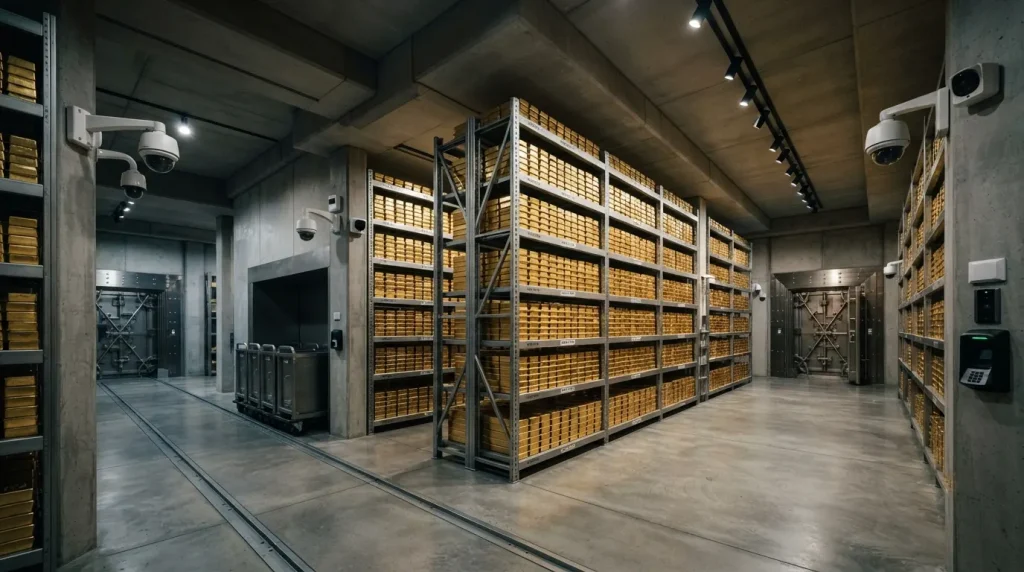
Owning gold and controlling its physical location are separate strategic decisions. Central banks traditionally stored substantial quantities in major international financial centers, including London. But the latest survey suggests that some institutions are becoming more interested in geographic diversification.
The World Gold Council reported that 9% of surveyed central banks had increased domestic gold storage during the previous 12 months, compared with 5% in the prior survey. Another 10% had diversified their overseas storage locations, compared with just 2% previously.
The Bank of England remained the most popular vaulting location, cited by 57% of respondents, while domestic storage was cited by 49%.
Gold Buying Is Still Accelerating
Storage decisions are occurring alongside continued purchases. World Gold Council data showed central banks and other official institutions made approximately 289 tonnes of net purchases in the second quarter of 2026, a substantial rebound from the revised first-quarter figure.
Poland and China were among the notable buyers, while central-bank demand remained broad despite periods of selling by other countries. The World Gold Council’s Q2 2026 data describes demand as continuing to reflect diversification and geopolitical uncertainty.
Is This a Move Away From the Dollar?
Gold’s growing role does not automatically mean that central banks are abandoning the U.S. dollar. Reserve managers typically balance multiple assets based on liquidity, safety, return and diversification requirements.
However, the World Gold Council’s 2026 survey found that 74% of respondents expected the U.S. dollar’s share of global reserves to be lower five years from now, while 83% expected gold to represent a larger share of reserves. That suggests a gradual diversification trend rather than an overnight replacement of the dollar.
Why Repatriation Can Be Politically Significant
Moving bullion into domestic vaults can give governments greater direct control over an important strategic asset. It can also become a powerful political signal when relations between major economies deteriorate.
Yet relocation is not necessarily a response to an immediate crisis. Vault security, transportation costs, liquidity requirements, operational arrangements and relationships with international financial institutions all influence where bullion is held.

A New Era of Reserve Management
The modern gold strategy is therefore more sophisticated than simply accumulating bars. Central banks are considering how much gold to own, how it fits alongside currencies and other reserve assets, and where the physical metal should be stored.
As geopolitical uncertainty and concerns about financial fragmentation continue, gold’s traditional role as a long-term store of value is being combined with a newer role as a strategic risk-management asset.
The result could be a lasting transformation in global reserve management. Central banks may not be abandoning traditional financial systems, but they are increasingly seeking greater diversification, resilience and control—and gold sits directly at the intersection of all three.
#GoldReserves #CentralBanks #GoldRepatriation #GlobalFinance #Geopolitics #GoldMarket #ReserveDiversification #FinancialMarkets #Economy #Investing #FinanceTrends