

Venezuela’s political upheaval has entered a new and potentially transformative phase. Months after U.S. forces captured Nicolás Maduro and brought him to the United States to face federal drug-trafficking charges, Washington and Venezuela’s interim government have unveiled an extraordinary oil agreement that could reshape the country’s energy industry and its relationship with the United States.
Maduro was captured during a U.S. military operation in January 2026 and subsequently pleaded not guilty in a New York federal court. Reuters reported that Maduro rejected the charges while describing his capture as unlawful. His detention fundamentally changed the political equation surrounding Venezuela.
A Massive Oil Gamble
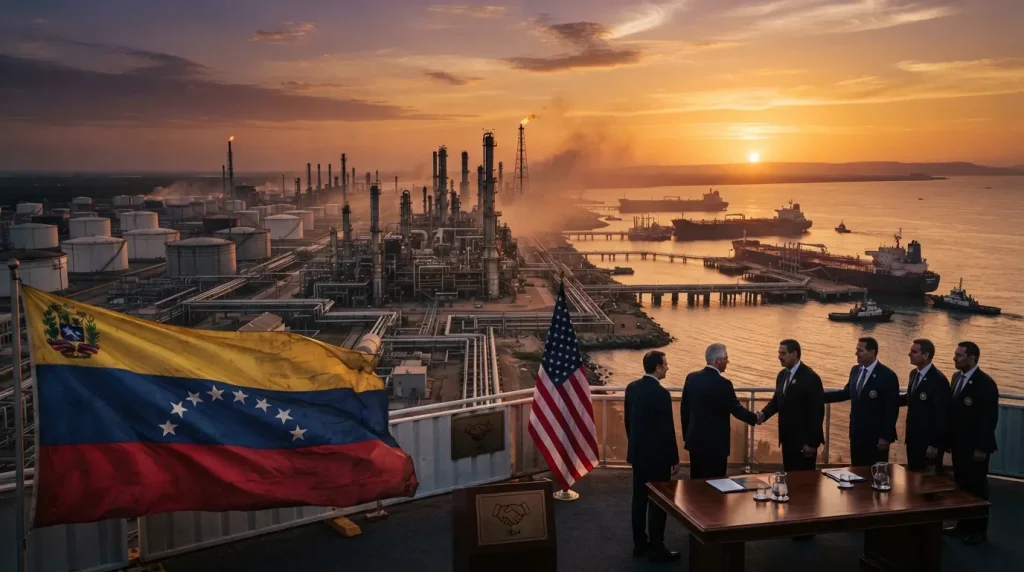
On August 28, U.S. President Donald Trump announced an agreement giving the United States substantial control and access to part of Venezuela’s enormous petroleum reserves. Reuters reported that the agreement focuses on approximately 65 billion barrels of proven reserves and is intended to revive Venezuela’s badly damaged oil industry.
The proposed structure goes beyond conventional energy investment. According to Associated Press, the arrangement involves a U.S. government stake in a venture developing 17 oil fields, with the Pentagon expected to hold a 35% equity position and the United States receiving preferential access to part of the production.

Why the Deal Is So Controversial
The agreement has immediately raised questions about Venezuelan sovereignty, transparency and the future political status of the country. Venezuela’s interim President Delcy Rodríguez has insisted that the country retains sovereignty over its natural resources. Al Jazeera reported that Caracas expects substantial revenue from oil sold under the arrangement.
Critics, however, question whether such a sweeping energy agreement can remain politically sustainable. The Council on Foreign Relations notes that Venezuela’s political and economic crisis has deep roots, meaning rebuilding the energy sector will require more than access to capital and foreign technology.
China and Russia Face a Strategic Setback
The agreement also has major geopolitical implications. Venezuela’s oil industry has historically maintained important relationships with Chinese and Russian interests. Washington’s push to redirect production toward U.S. markets could therefore reduce the influence those countries have built in Venezuela.
Reuters reported that some Chinese- and Russian-linked operators could lose projects under the new arrangement, while U.S. officials openly frame the deal as a way to increase American influence over Venezuela’s energy sector.
Can Venezuela Actually Deliver?
One major uncertainty is infrastructure. Years of economic crisis, sanctions and underinvestment have damaged Venezuela’s oil-producing capacity. Reuters reported that production could eventually rise substantially, but the proposed structure still faces legal, financial and operational questions.
That makes the deal a long-term gamble rather than an immediate solution to U.S. energy prices. Reviving Venezuela’s heavy-oil industry requires investment, technology, infrastructure and political stability.
A New Chapter for Venezuela
Maduro’s detention and the oil agreement are therefore deeply connected. The removal of Venezuela’s former leader created the political conditions for Washington to pursue a dramatically different relationship with Caracas.
Whether that relationship becomes a model for Venezuela’s economic recovery or a source of prolonged controversy remains uncertain. What is clear is that Venezuela’s vast oil reserves have once again become central to the country’s politics — and to the broader struggle for influence across the Western Hemisphere.
#Venezuela #Maduro #MaduroUSCustody #VenezuelaOil #OilDeal #DonaldTrump #DelcyRodriguez #USVenezuela #Geopolitics #EnergyPolitics #OilMarkets #LatinAmerica #WorldNews #InternationalRelations