

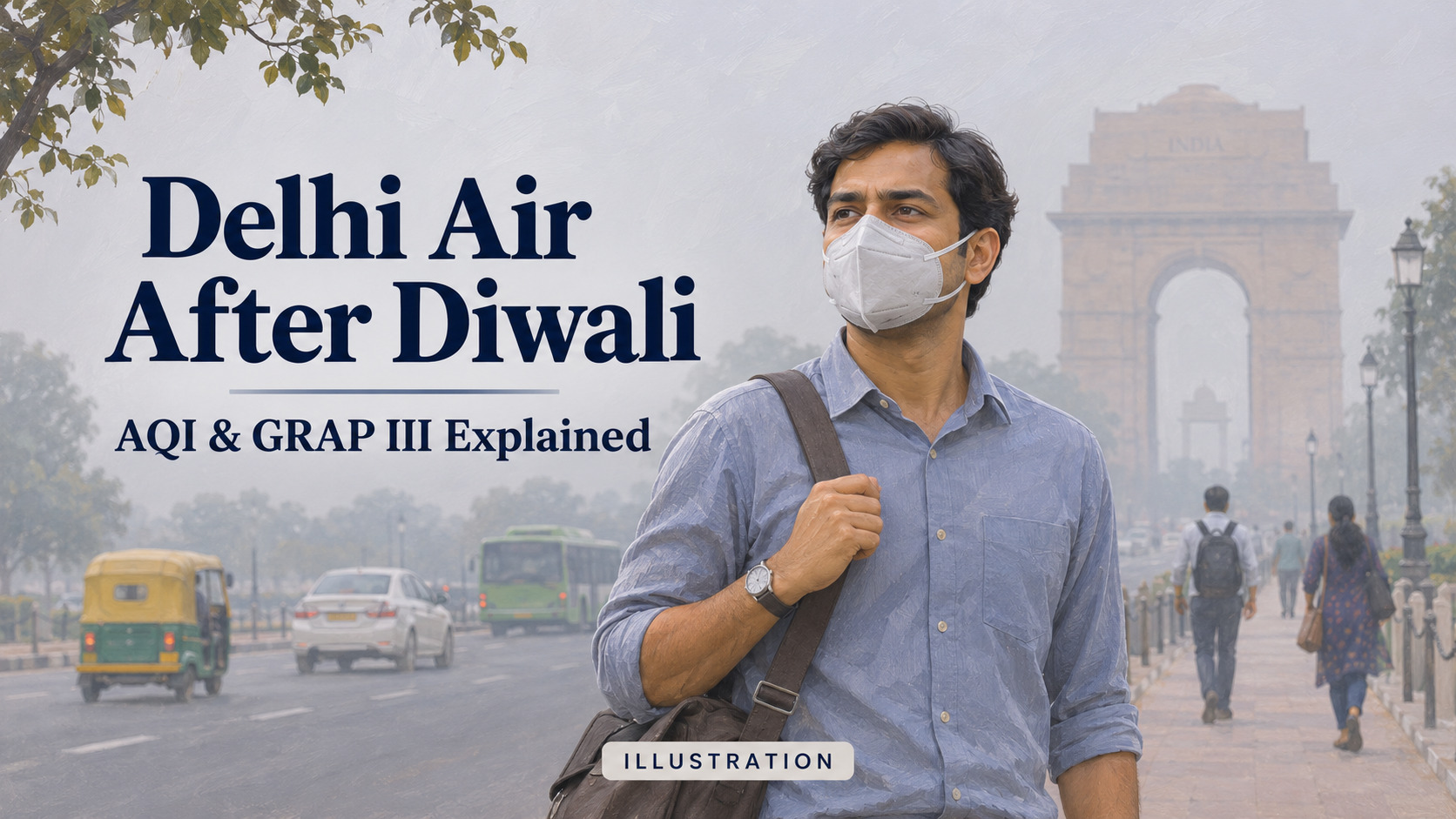
Delhi residents checking the air after Diwali face two practical questions: how polluted is their neighbourhood, and which restrictions affect their day? The answer requires checking both the pollution reading and the latest official order.
Reuters reported Delhi’s AQI at 370 at 9 a.m. on 9 November, placing the city in India’s “very poor” category, while several neighbourhoods recorded readings above 400. These figures are a morning snapshot, not the final daily bulletin. Reuters
The Commission for Air Quality Management (CAQM) invoked GRAP Stage III on 6 November, citing a daily average AQI of 382 and forecasts of deterioration. Its announcement said the earlier Stage I and II measures would continue alongside Stage III. Official announcement
What does Delhi’s AQI number mean?
India’s Air Quality Index translates pollution measurements into a number and category. It is an index, not a percentage or the measured concentration of a single pollutant. CPCB’s method calculates pollutant sub-indices and uses the worst sub-index to determine the overall AQI. CPCB explanation
| Indian AQI | Category | CPCB’s broad health interpretation |
|---|---|---|
| 0–50 | Good | Minimal impact |
| 51–100 | Satisfactory | Sensitive people may experience minor breathing discomfort |
| 101–200 | Moderate | People with lung or heart disease may experience breathing discomfort |
| 201–300 | Poor | Prolonged exposure may cause breathing discomfort for most people |
| 301–400 | Very poor | Prolonged exposure may cause respiratory illness |
| 401–500 | Severe | Can affect healthy people and seriously affect those with existing diseases |
Source: CPCB AQI information. These categories communicate population-level risk; they do not diagnose an individual’s health.
Why can one app say “very poor” while another says “severe”?
First check the location, timestamp and AQI scale. A city summary and a neighbourhood station describe different things. CPCB acknowledges that air quality varies between monitoring locations and that an average simplifies those differences.
An hourly display may also differ from a daily bulletin. International apps may use a different index: WHO cautions that AQI calculation methods and thresholds vary between countries, making direct comparisons potentially misleading. CPCB · WHO
For a useful check, record the station, observation time and whether the display uses India’s AQI. Avoid treating an undated screenshot as today’s reading.
Which GRAP III restrictions apply?
The following is a summary of selected provisions in the revised schedule attached to CAQM’s 6 November order. Individual provisions have different geographic scopes and exemptions. CAQM order and schedule
| Activity | What the Stage III schedule provides |
|---|---|
| Cars and other four-wheeled light motor vehicles | Restrictions cover BS III petrol and BS IV diesel or below-standard vehicles in Delhi, Gurugram, Faridabad, Sonipat, Ghaziabad and Gautam Buddha Nagar. Check applicable exemptions. |
| Primary schools | Classes up to Class V must operate in hybrid mode, where online learning is feasible, in Delhi, Gurugram, Faridabad, Ghaziabad and Gautam Buddha Nagar. Guardians and students choose online participation where available. |
| Construction and demolition | Specified dust-generating work is restricted across NCR; exemptions and permitted activities must be checked against the order. |
| Offices | The schedule calls for government decisions on 50% office attendance and work-from-home arrangements; check the implementing direction applicable to your workplace. |
For vehicle checks, consult the registration record and current transport notice. The September 2026 revision specifically extended the relevant light-vehicle restrictions to Sonipat and tightened provisions for certain goods vehicles. Do not assume a goods vehicle follows the same rules as a private car. Government summary of the revision
Are all schools closed? Is every office working from home?
Hybrid schooling allows physical and online learning; it is not a blanket school-closure announcement. Parents should obtain their school’s current instructions rather than extrapolate the primary-school provision to every class.
Office requirements also need a separate check. SCC Times reports that a 30 October CAQM order, covering 5–20 November, directs up to 50% physical attendance in specified government and private offices in Delhi and five NCR districts, with exceptions. That report concerns an additional direction, not simply the general Stage III wording. Confirm the applicable notice with your employer or authority. SCC Times report
Why did Stage III begin before the city average reached 401?
GRAP can be activated preventively. CAQM’s 6 November announcement cited unfavourable weather, poor pollutant dispersion and forecasts that air quality could enter the severe category. A “very poor” city reading therefore does not, by itself, establish that Stage III has been withdrawn. Check the latest invocation or revocation order. CAQM announcement
Is Diwali the only reason for the pollution?
Fireworks added to an existing seasonal problem. Reporting on 9 November also identified traffic emissions, construction dust and crop-burning smoke, with cold, stagnant air limiting dispersion. That does not establish a precise contribution from each source on a particular street or day. Reuters
What can residents do today?
Check local readings before planning prolonged outdoor exertion and follow public-health advice, particularly for family members with existing illnesses. WHO discusses reducing exposure through activity choices, suitable respirators and portable indoor air cleaners, while stressing that reducing emissions is the preferred public-health response. Personal measures cannot remove the need for cleaner air. WHO guidance
CAQM also asks residents to combine journeys, choose cleaner transport and avoid burning coal or wood for heating. Its citizen charter says to follow hybrid-schooling and work-from-home instructions when issued. Citizen charter announcement
Before leaving home, check three items: the latest nearby AQI reading, the official order affecting your activity, and the notice from your school or employer. A pollution category describes the air; an official direction establishes the restriction.