

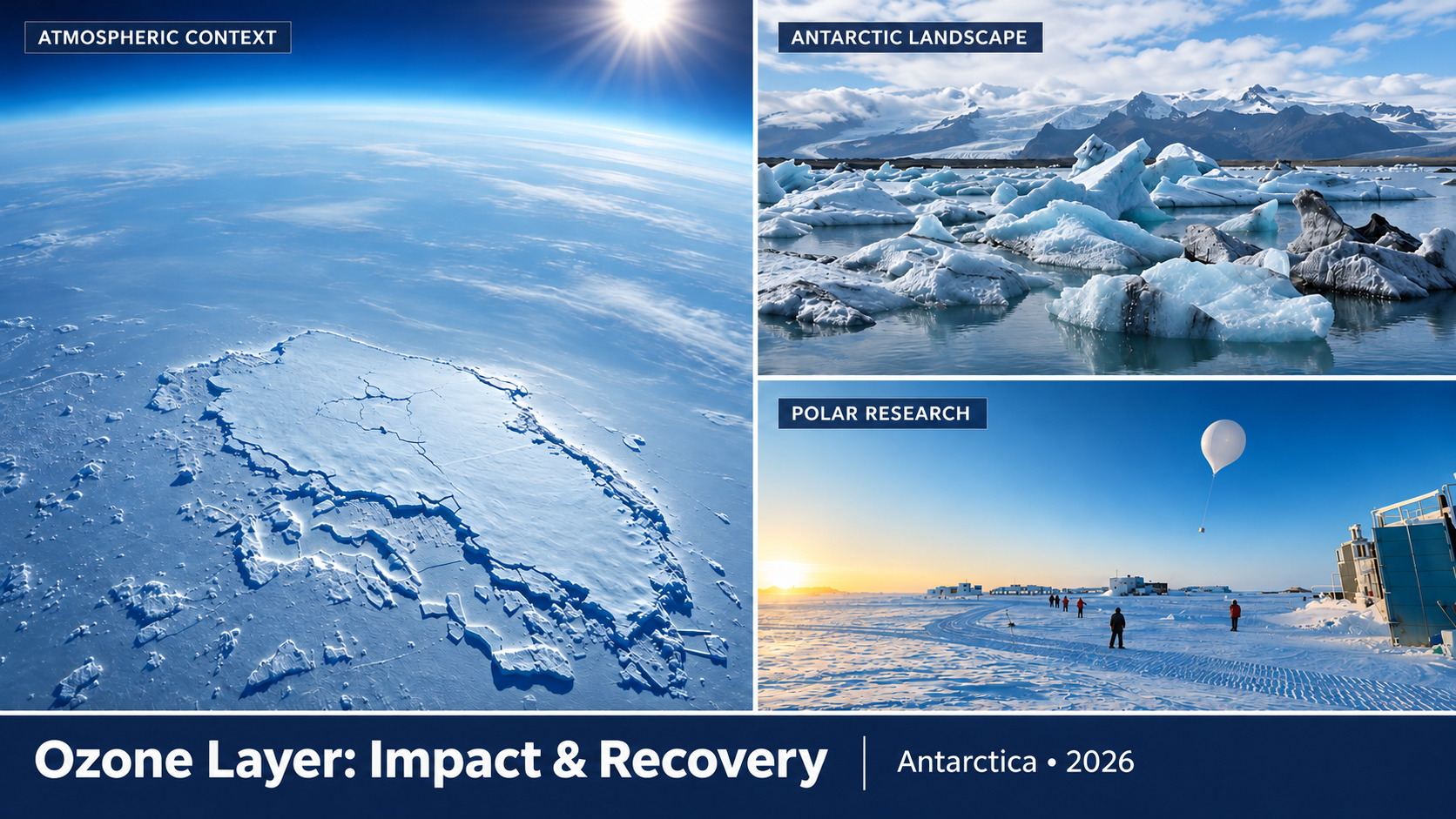
Antarctica’s ozone hole was unusually large in 2026, yet scientists say the ozone layer remains on a long-term recovery path. Those findings describe different aspects of the atmosphere: the severity of one season and the gradual effect of reducing ozone-destroying chemicals.
In its 4 November release, NOAA reported that the 2026 hole ranked seventh largest in 48 years of monitoring by seasonal mean area. Its average extent during the 7 September–13 October peak-depletion period was about 25 million square kilometres. The largest single-day area was 27.1 million square kilometres on 18 September. NOAA findings
NASA’s Earth Observatory highlighted the results on 9 November, explaining that the hole was large in area but less deeply depleted than some other large holes on record. The September maximum and November publication dates refer to different events: the measurement and the subsequent explanation. NASA explainer
A “hole” means thinning, not an empty gap
The ozone hole is a region of unusually depleted ozone above Antarctica. Scientists define its boundary using total-column ozone below 220 Dobson units. It is not a literal opening with no atmosphere or ozone remaining.
That distinction helps explain why size alone cannot tell the whole story. NASA
| Measurement | What it describes | What readers should check |
|---|---|---|
| Area | Geographic extent below the ozone threshold | Is the figure a daily maximum or a seasonal average? |
| Depth | How strongly ozone is depleted within the region | Which location and minimum measurement are being compared? |
| Duration | How long the depleted region persists | Does the comparison cover the same part of the season? |
| Recovery | Change over many years | Are weather variations separated from the longer trend? |
The seventh-largest ranking applies to the seasonal average. Calling it the “seventh-largest daily maximum” would change the meaning of the finding.
Why was the 2026 hole so large?
NOAA attributed the season’s unusual extent to a powerful Antarctic polar vortex. This circulation helps isolate cold air, creating conditions that support ozone depletion. Scientists said weaker weather disturbances allowed the vortex to remain unusually strong.
The weather acted alongside the remaining ozone-depleting chemicals. NOAA said the hole would have been larger if those chemicals had remained at their earlier peak levels. NOAA
Does this mean ozone protection has failed?
The Ozone Secretariat reports evidence of Antarctic recovery since 2000, alongside substantial annual variation driven by meteorological conditions. It also reports that implementation of the Montreal Protocol has phased out 99% of ozone-depleting substances under the treaty’s controls. Ozone Secretariat facts
The central distinction is between reducing the chemical cause over decades and weather influencing an individual season. A difficult season does not, by itself, measure whether the treaty is succeeding.
Recovery also takes time. The Secretariat explains that future ozone levels depend on declining ozone-depleting substances, continued treaty compliance and changes in climate. Large volcanic eruptions can temporarily affect ozone too. Ozone science questions and answers
When will the ozone layer recover?
Recovery dates are projections tied to a region, reference year and modelling assumptions. They should not be presented as guaranteed deadlines.
The Ozone Secretariat’s summary cites a return to 1980 total-column ozone values around 2066 over Antarctica, assuming continued compliance. NASA’s November 2026 explanation uses the broader 2070s timeframe for Antarctic recovery. These sources do not provide an identical date, so a precise year needs attribution. Ozone Secretariat · NASA
The shared message is that Antarctic recovery is a process measured in decades. A projection is not evidence that the hole has already closed.
Why should readers outside Antarctica care?
Most atmospheric ozone is in the stratosphere, where it absorbs harmful ultraviolet radiation. The Ozone Secretariat explains that ozone depletion can affect human health, agriculture and ecosystems through increased UV exposure. Ozone Secretariat
This Antarctic finding is not a measurement of a reader’s local UV exposure. It is also separate from ground-level ozone pollution: NOAA distinguishes the protective stratospheric layer from ozone near the surface, which is an air pollutant. NOAA
The 2026 result makes a useful test for environmental headlines: check what was measured, over which period, and against which baseline. Those details explain how an unusually large seasonal ozone hole can coexist with evidence of long-term recovery.