

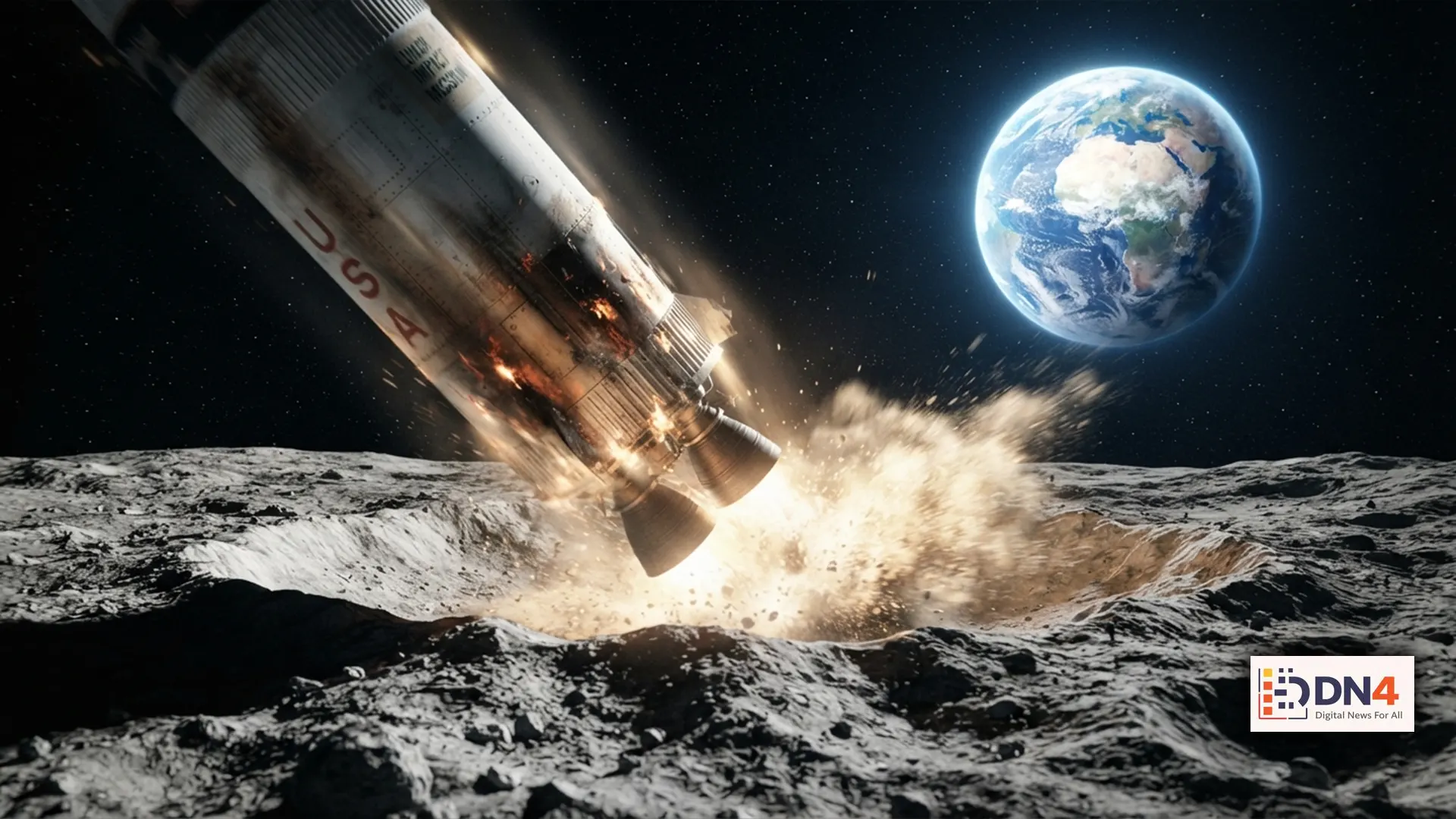
A massive rocket component roughly the size of a school bus has collided with the Moon, creating fresh excitement among planetary scientists. While a spacecraft impact might sound alarming, researchers view these controlled or accidental lunar collisions as rare scientific opportunities that can reveal valuable insights into the Moon’s surface, geology, and the long-term effects of space debris.
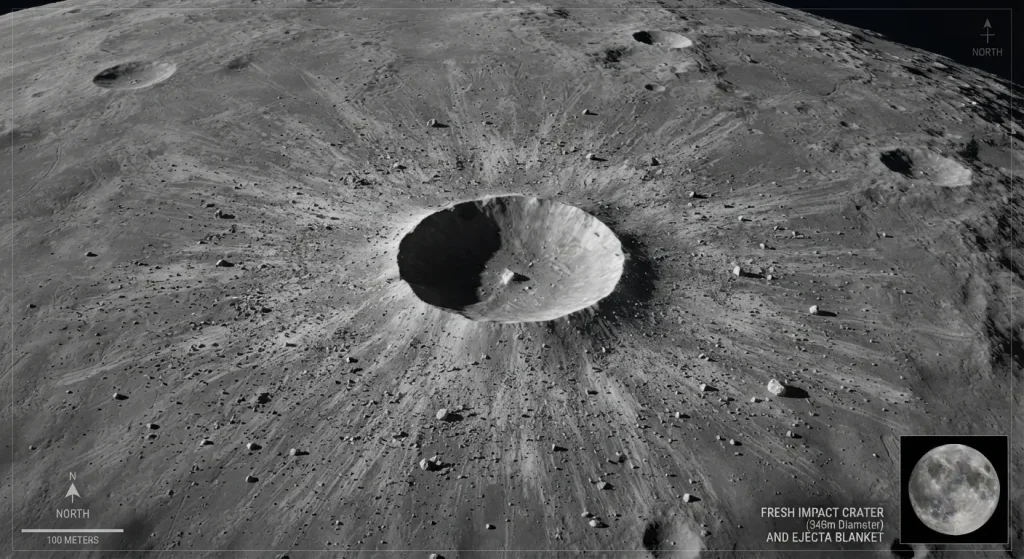
The impact generated a new crater that scientists can study using orbiting spacecraft equipped with high-resolution cameras. Missions such as NASA’s Lunar Reconnaissance Orbiter (LRO) regularly photograph the Moon’s surface, allowing researchers to compare before-and-after images of impact sites. These observations help scientists understand how lunar craters form and how material is ejected during collisions.
Why a Rocket Impact Is Valuable for Science
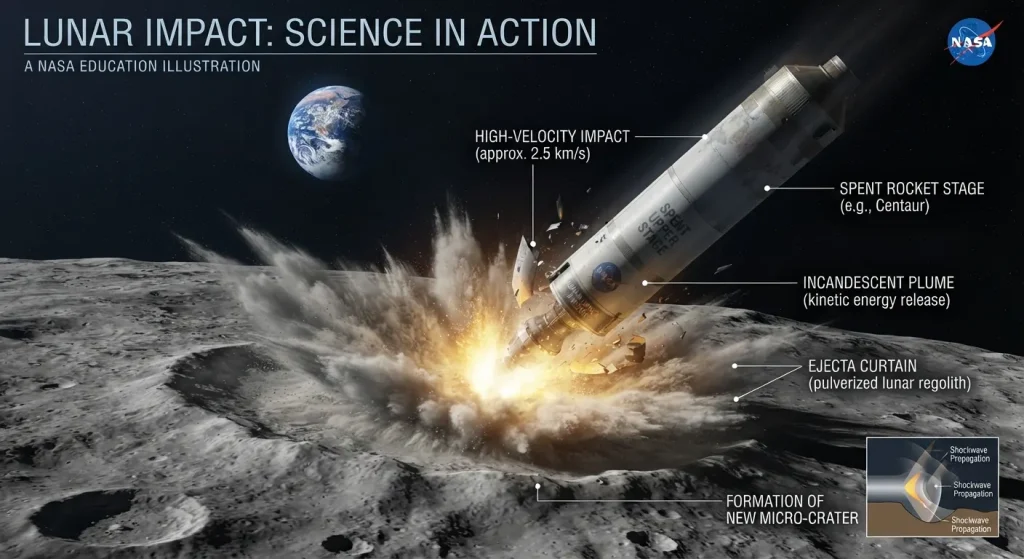
Unlike natural meteorite strikes, a known rocket stage provides scientists with a relatively predictable object whose size, approximate mass, and impact location can often be estimated. This gives researchers a unique opportunity to compare theoretical models with real-world observations.
Data collected from fresh impact sites also improves our understanding of the Moon’s dusty surface, known as the lunar regolith. According to NASA’s Moon Exploration Program, studying lunar geology is essential for planning future robotic missions and long-term human exploration.
Why the Moon Keeps Getting Hit
The Moon has virtually no atmosphere capable of burning up incoming objects, meaning meteoroids and abandoned spacecraft can strike its surface directly. Because there is no wind or flowing water to erode impact craters, these scars often remain visible for millions of years, providing an extraordinary record of the Solar System’s history.
Space agencies including the European Space Agency (ESA) and NASA’s Jet Propulsion Laboratory continue studying lunar impacts to improve models of crater formation and planetary evolution.
What Scientists Hope to Learn
Researchers analyze the size, depth, and debris pattern of the new crater. This helps them better understand the physical properties of the Moon’s surface. Researchers compare these observations with computer simulations to refine impact models. These models are used to study impacts across the Solar System, including on Mars, Mercury, and asteroids.
Fresh craters also expose material buried beneath the lunar surface. This gives scientists a rare glimpse into geological layers that have remained undisturbed for billions of years. These findings may help future lunar missions identify promising locations for exploration and resource studies.
The Bigger Picture for Space Exploration
As governments and private companies accelerate lunar exploration, understanding how artificial objects interact with the Moon is becoming increasingly important. Future missions under programs such as NASA’s Artemis Program aim to establish a long-term human presence on the lunar surface, making detailed knowledge of lunar terrain more valuable than ever.
A rocket crashing into the Moon may sound dramatic, but scientists see it as a fortunate research opportunity. Every new impact offers another chance to unlock secrets about our closest celestial neighbor. It also deepens humanity’s understanding of planetary science.
#SpaceX #Moon #SpaceExploration #NASA #Astronomy #ScienceNews #LunarResearch