

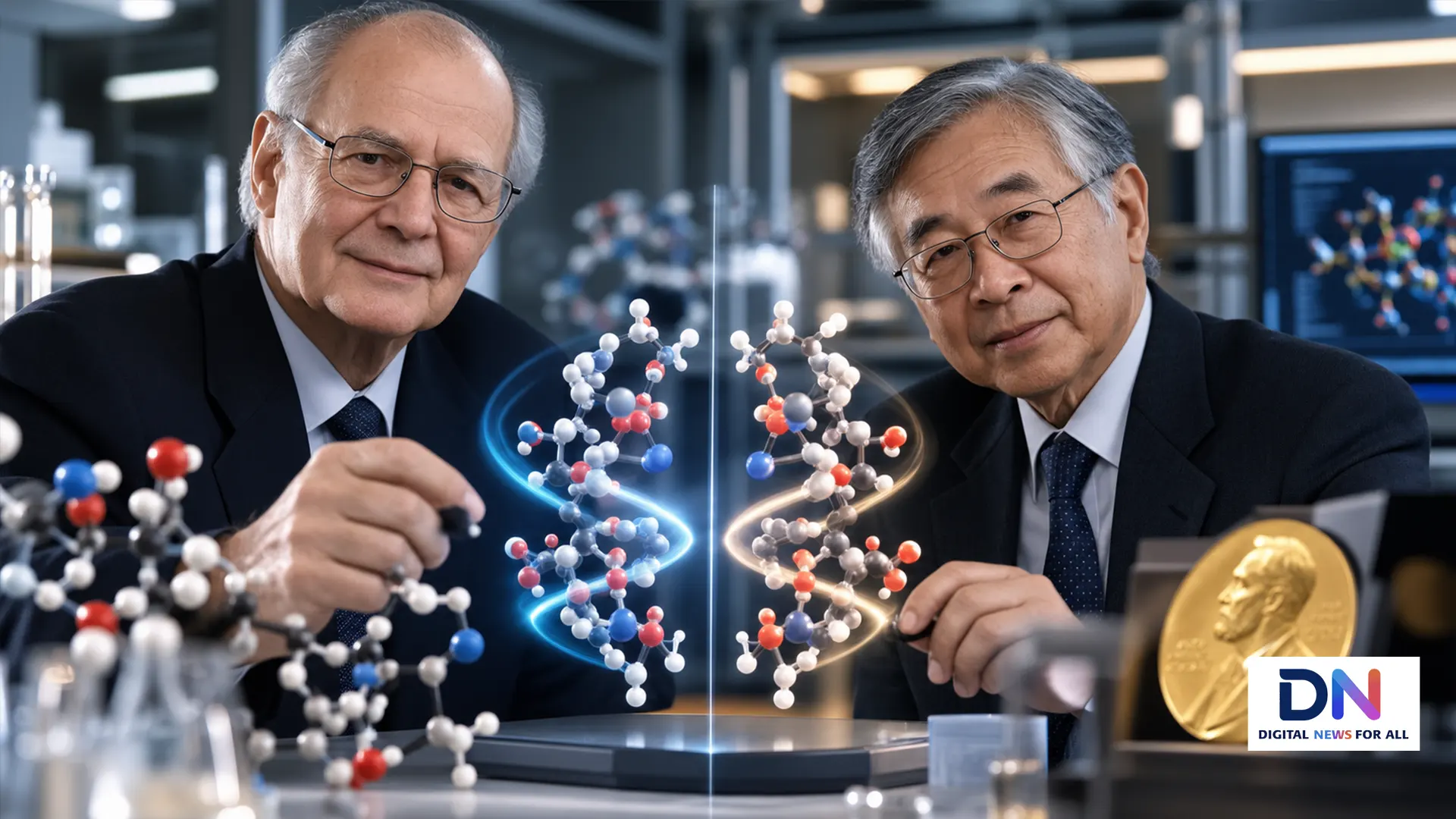
The 2026 Chemistry Nobel has answered a scientific question that has puzzled researchers for more than a century: why does life overwhelmingly favor one version of certain mirror-image molecules? Henri B. Kagan and Kenso Soai were awarded the prize on October 7 for discoveries involving non-linear effects and autocatalysis in asymmetric organic synthesis.
A Mystery That Began With Molecular “Hands”
Some molecules exist in two forms that are mirror images of each other. Chemists call this property chirality, from the Greek word for hand. Like left and right hands, the two molecular forms can look almost identical while behaving very differently inside biological systems.
The mystery goes back to Louis Pasteur’s 19th-century experiments. Scientists eventually discovered that biological systems overwhelmingly use one molecular orientation, a phenomenon known as homochirality. But explaining how that preference could emerge remained a major scientific challenge.
What Kagan and Soai Discovered
Kagan’s work in the 1980s demonstrated that tiny differences in molecular handedness could be amplified during chemical reactions. Soai later showed that a chiral molecule could act as a catalyst that helps produce more molecules with the same handedness.
That autocatalytic process offered a mechanism through which a small initial imbalance could become overwhelmingly one-sided. The Royal Swedish Academy of Sciences recognized the work as a solution to the century-old question of how homochirality can emerge spontaneously.
Why It Matters for Medicine
The discovery is more than a theoretical chemistry breakthrough. Pharmaceutical molecules can have different biological effects depending on their molecular orientation.
Being able to selectively manufacture one chiral form gives drug developers greater control over medicines. The Nobel Prize organization describes this ability as important for designing and producing pharmaceuticals.
The implications extend beyond medicine. The Royal Society of Chemistry notes that controlling molecular handedness can also matter for fragrances, flavors and other chemical products.
Could This Shape Future Technology?
The biggest technological impact may come from better control of complex chemical manufacturing. More selective reactions can reduce unwanted molecular byproducts and potentially make the production of sophisticated compounds more efficient.
That could become increasingly important as biotechnology, precision medicine and advanced materials continue to develop. However, the Nobel Prize recognizes fundamental chemistry; it does not mean a new commercial technology will appear immediately.
A Century-Old Question Finally Has an Answer
The significance of the 2026 Chemistry Nobel is therefore both historical and practical. Kagan and Soai connected a fundamental mystery about life’s molecular architecture with powerful methods for controlling chemical reactions.
The breakthrough reminds us that some of tomorrow’s most important technologies begin with questions that seem impossibly basic today. By explaining how molecular “handedness” can become dominant, this year’s Nobel-winning chemistry could influence how scientists design medicines and other complex molecules for decades to come.
#NobelPrize #Chemistry #NobelChemistry #Science #HenriKagan #KensoSoai #Chirality #Pharmaceuticals #FutureTech #Innovation