

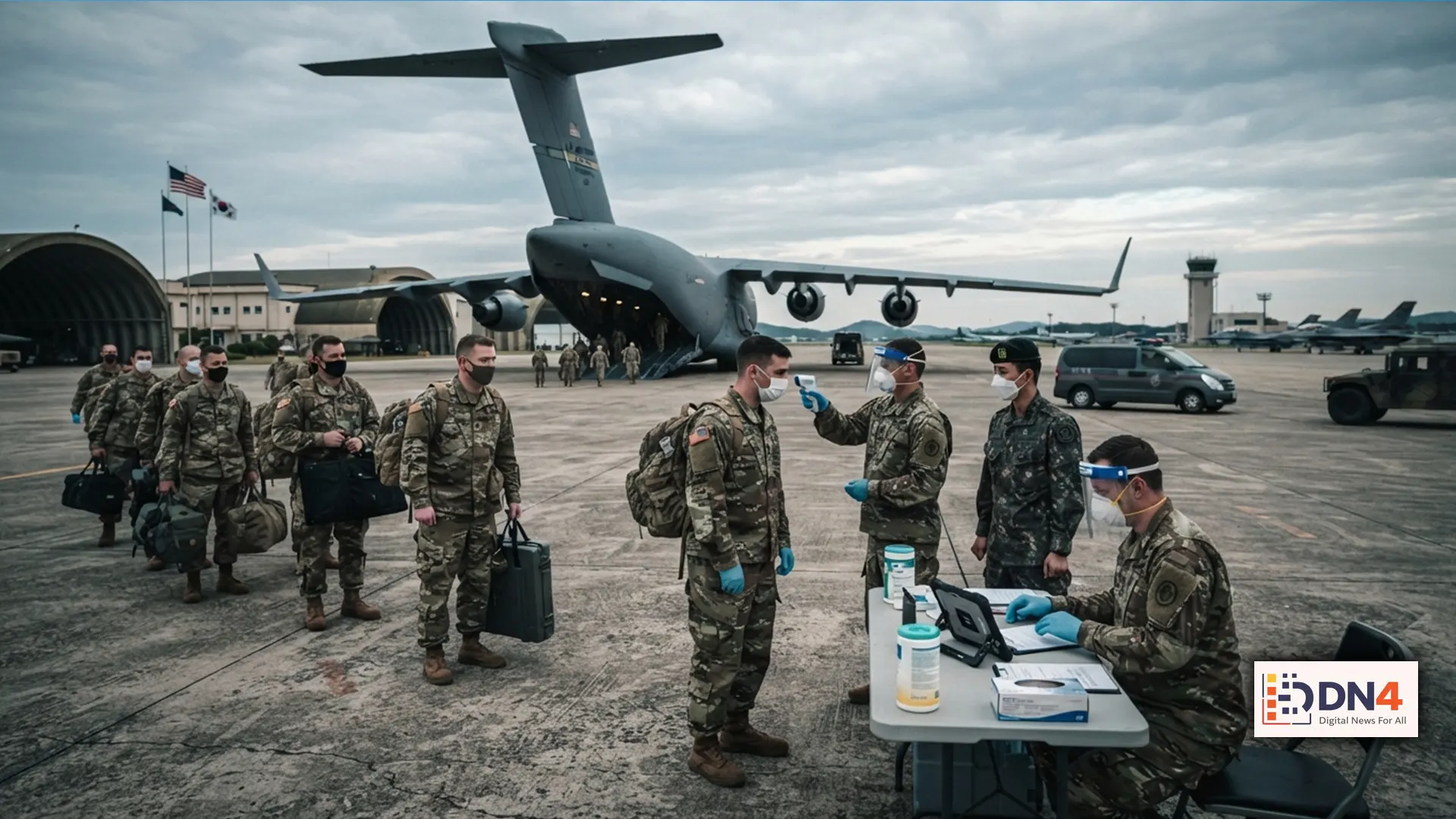
Infectious disease screening is returning for U.S. military personnel arriving on the Korean Peninsula, marking a significant post-pandemic shift in public-health cooperation between the United States and South Korea. U.S. Forces Korea (USFK) and the Korea Disease Control and Prevention Agency (KDCA) signed a memorandum of understanding on August 13, 2026, to restore quarantine procedures that had been suspended after the COVID-19 pandemic. USFK’s announcement says the agreement is designed to strengthen joint protection against infectious disease threats.
What Is Changing for Arriving Troops?
The renewed procedures apply to passengers arriving in South Korea aboard U.S. military and military-contracted aircraft. The arrangement does not currently cover Department of Defense personnel arriving on commercial flights under the same aircraft-specific procedures.
Under the agreement, USFK will conduct health screening and can arrange testing, isolation, treatment, contact tracing and disinfection when circumstances require it. Confirmed cases involving designated quarantine infectious diseases are to be reported to the KDCA immediately.
Seven Locations Covered by the Agreement
The expanded system covers seven U.S. military-related locations: Osan Air Base, Camp Humphreys, and airports at Kunsan, Daegu, Gimhae, Gwangju and Suwon. The nationwide expansion represents a broader framework than the earlier system, which was primarily centered on Osan Air Base.
The Korea Disease Control and Prevention Agency will also receive infectious-disease information through the bilateral cooperation framework established under the U.S.-South Korea Status of Forces Agreement.
Why Screening Is Returning
Officials have emphasized that the renewed cooperation was not triggered by a specific outbreak. Instead, the two countries are restoring procedures that were suspended following COVID-19. They’re also improving information sharing and preparedness for future infectious disease threats.
The timing also reflects the continuing importance of infectious-disease surveillance for military readiness. Recent U.S. military health data found that 80% of reported malaria cases in 2025 were acquired in Africa or Korea-related settings, with most U.S. service-member P. vivax malaria cases acquired in Korea. The findings reinforce the importance of region-specific disease prevention and surveillance. Military Health System research highlights surveillance and preventive measures as important elements of force health protection.
A Different Approach From the COVID-19 Era
During the pandemic, health controls for military arrivals were substantially more intensive. At Osan, arriving personnel were questioned about symptoms and recent contacts, while inbound personnel underwent testing shortly after arrival. Those measures were gradually eliminated as South Korea relaxed its pandemic restrictions.
The new framework is broader but does not necessarily mean every traveler will undergo the same intensive testing used during COVID-19. USFK and KDCA are still coordinating implementation details, including exactly how screening will be conducted.
What It Means for the US-South Korea Alliance
The agreement demonstrates that military readiness increasingly includes public-health preparedness. For the United States and South Korea, rapid communication about infectious diseases can help protect service members, military families, and surrounding communities. It also reduces the risk of an outbreak spreading through military transportation networks.
The new policy doesn’t represent a return to blanket pandemic restrictions. Instead, it establishes a standing framework that can be activated when infectious-disease risks warrant additional measures. It combines military readiness with public-health coordination and gives both countries a clearer mechanism for responding to future health threats.
As implementation proceeds, arriving personnel and their families will likely be watching for additional guidance about screening procedures. For now, the central message is preparedness: the post-pandemic era does not eliminate infectious-disease risks, and military organizations are rebuilding systems designed to respond to them.
#USFK #SouthKorea #USMilitary #InfectiousDisease #DiseaseScreening #MilitaryHealth #PublicHealth #COVID19 #Quarantine #MilitaryReadiness #Korea #USSouthKorea