

 By vinodkram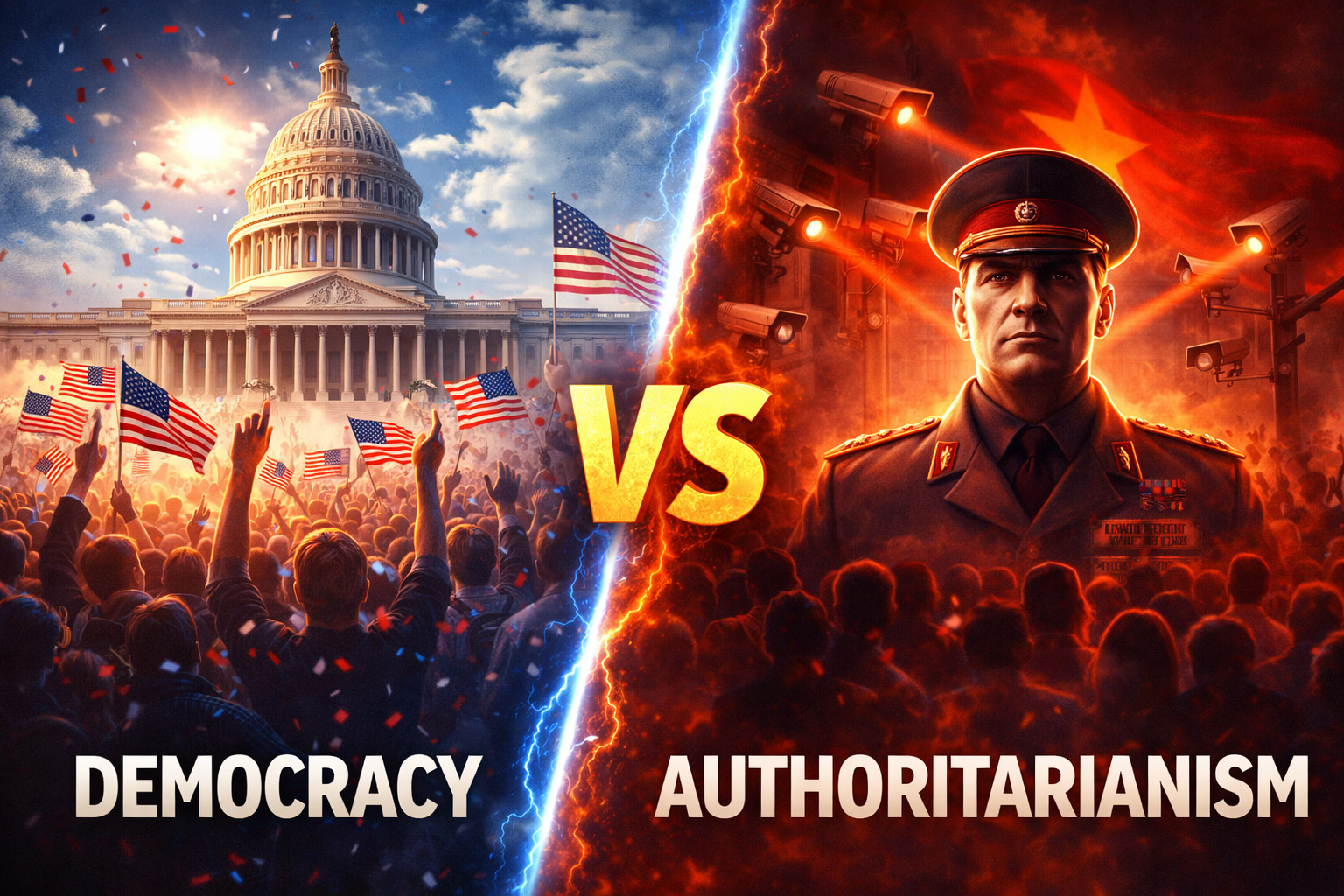
In 2026, the types of government shaping the world—especially the ongoing debate between democracy vs authoritarianism—are at the center of political and economic discussions in the United States. As elections, policy shifts, and global tensions rise, understanding these systems is no longer optional. It directly impacts freedom, financial stability, and the future of societies.
Democracy: Power, Participation, and Accountability
Democracy remains one of the most influential systems of governance in the modern world. Countries like the United States, the United Kingdom, and Canada operate under democratic frameworks that prioritize citizen participation and accountability.
There are two primary forms of democracy. Direct democracy allows citizens to vote on policies themselves, while representative democracy involves electing officials to make decisions on behalf of the public.
In 2026, democracy is under intense scrutiny. Issues such as election transparency, digital voting systems, and political polarization are shaping national conversations. In the United States, debates over federal and state authority continue to redefine how democracy functions.
Authoritarianism: Control, Efficiency, and Risk
Authoritarianism represents a contrasting approach where power is centralized in the hands of a single leader or a small group. Political freedoms are limited, and opposition is often restricted.
This system is gaining attention globally due to its perceived efficiency in decision-making. Governments can implement policies quickly without the delays seen in democratic systems. However, this often comes at the expense of civil liberties and transparency.
As global tensions rise, more people are questioning whether efficiency should come before freedom, making authoritarianism a key topic in political discussions.
Democracy vs Authoritarianism: A Defining Global Debate
The comparison between democracy and authoritarianism is one of the most significant discussions of our time.
Democracy emphasizes individual rights, public participation, and accountability. Authoritarianism focuses on centralized control and rapid decision-making. While democracies may move slower, they are designed to protect freedoms. Authoritarian systems may act faster but often limit personal rights.
This debate is particularly relevant in the United States, where concerns about political stability, economic growth, and governance models are increasingly interconnected.
Monarchy: Tradition in a Modern World
Monarchy continues to exist in both traditional and modern forms. Absolute monarchies grant full power to a ruler, while constitutional monarchies limit that power through laws and elected governments.
Countries like the United Kingdom and Japan demonstrate how monarchy can coexist with democratic systems, offering stability and cultural continuity.
Socialism vs Communism: Understanding the Difference
Discussions around socialism and communism are becoming more prominent in the United States, particularly in debates about healthcare, education, and economic inequality.
Socialism supports a mixed economic system with government involvement in key sectors. Communism, on the other hand, aims for a classless society with no private ownership.
Understanding these differences is essential for interpreting modern policy discussions and political ideologies.
Federal vs Unitary Systems: Distribution of Power
The way power is distributed within a country defines its governance structure.
The United States follows a federal system, where power is shared between national and state governments. This allows regional flexibility while maintaining national unity.
Unitary systems centralize power in a single national authority. While this can streamline decision-making, it may limit local autonomy.
Oligarchy: Concentration of Power
Oligarchy occurs when a small group of individuals holds significant power, often due to wealth or influence. This can exist within different political systems and often leads to inequality and reduced public trust.
Anarchism: A Different Perspective on Governance
Anarchism challenges traditional governance by advocating for self-organization without centralized authority. While not widely implemented, it offers an alternative perspective on freedom and cooperation.
Why Understanding Types of Government Matters in 2026
Political systems influence nearly every aspect of life, including economic policies, job markets, and personal freedoms. In a rapidly changing global landscape, understanding governance structures is essential for making informed decisions.
Conclusion
The types of government that shape our world today reflect different approaches to power, control, and societal organization. As global discussions around democracy vs authoritarianism continue to grow, staying informed is critical for navigating the future.
 Vinod Ram