


The $20,000 visa bond program has become a major new consideration for some people planning business or tourist travel to the United States. The permanent program allows U.S. consular officers to require certain B-1 and B-2 visa applicants from designated countries to post a financial bond of $10,000, $15,000 or $20,000 before a visa can be issued. The U.S. State Department’s current list identifies the countries covered by the policy.
Who Has to Pay the Visa Bond?
The requirement applies to nationals traveling on passports from designated countries who are otherwise eligible for a B-1 or B-2 visa. The bond amount is determined during the visa process. The final rule establishes three possible amounts: $10,000, $15,000 and $20,000. The Federal Register rule explains how consular officers determine the applicable amount.
The program currently covers 50 countries, including Bangladesh, Bhutan, Nepal, Nigeria, Venezuela and several African and Pacific nations. Importantly, India is not currently on the State Department’s visa-bond list. Travelers should check the official list because the designated countries and implementation dates can change.
Is the $20,000 a Visa Fee?
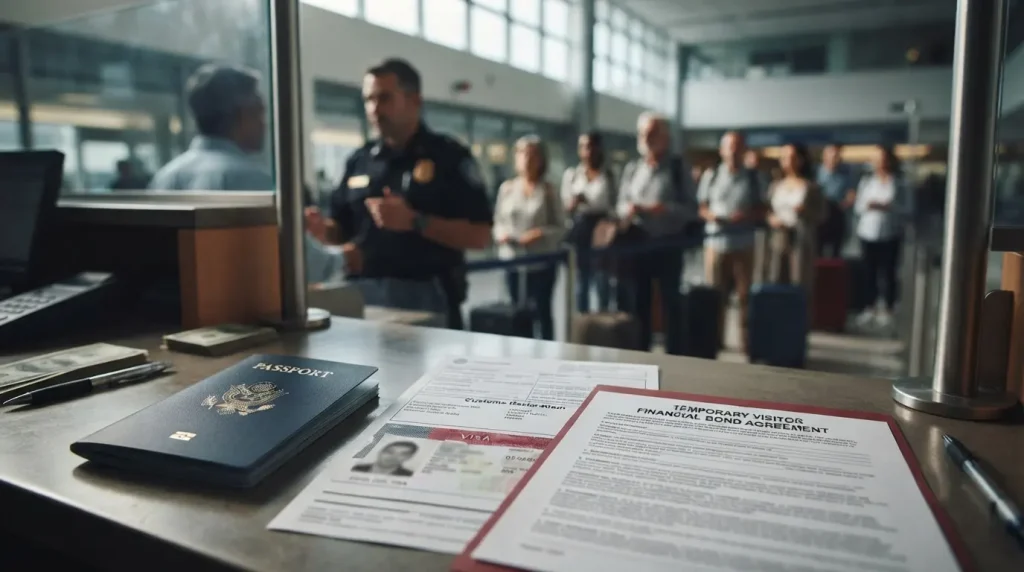
No. The bond is different from the normal visa application fee. It is financial security intended to encourage compliance with U.S. immigration rules. The bond can be paid by the applicant or by a third party, such as a family member or business associate. State Department guidance says the person who posts the bond is generally the person who receives the refund if the conditions are satisfied.
There is another important point: paying the bond does not guarantee visa approval. Applicants must still meet all other requirements for a B-1 or B-2 visa.
When Is the Money Returned?
The bond is generally refundable when the traveler follows the conditions attached to it. The government says the bond can be canceled when the visa expires without the traveler having entered the United States, or after the traveler leaves the country through an authorized commercial airport while complying with the visa conditions.
Visa-bond travelers must use designated commercial air ports of entry and exit. Land, sea and certain private-air travel options are excluded under the current rules. U.S. Customs and Border Protection provides additional information about entry procedures for international visitors.
Could It Hurt U.S. Tourism?
The economic impact could depend heavily on how many travelers actually face the maximum bond. For a family planning a vacation, temporarily tying up $20,000 can create a significant financial barrier, even if the money is eventually returned.
Travel businesses may also feel the effects if some prospective visitors decide that the financial requirement makes a U.S. trip too expensive or complicated. Hotels, airlines, restaurants, attractions and convention businesses all depend partly on international visitors.
Why the U.S. Introduced the Program
The State Department says the program is designed to address visa overstays and improve compliance with immigration requirements. The policy is authorized under Section 221(g)(3) of the Immigration and Nationality Act, and the covered countries are selected using B-1/B-2 overstay data.
The Department of Homeland Security’s overstay reporting provides the underlying data used in the government’s assessment of visa compliance.
What Travelers Should Do
Anyone from a designated country should verify the latest State Department requirements before paying anything. Applicants should only post a bond after a U.S. consular officer instructs them to do so and provides the official payment instructions. Pay.gov is the U.S. Treasury’s official online payment platform.
For international tourism, the central issue is therefore not simply the headline $20,000 visa bond. It is whether the added financial commitment changes who can realistically afford to visit the United States—and how that could reshape international travel demand.
#USVisa #VisaBond #Tourism #TravelNews #B1Visa #B2Visa #USImmigration #InternationalTravel #TravelUpdate #USNews