

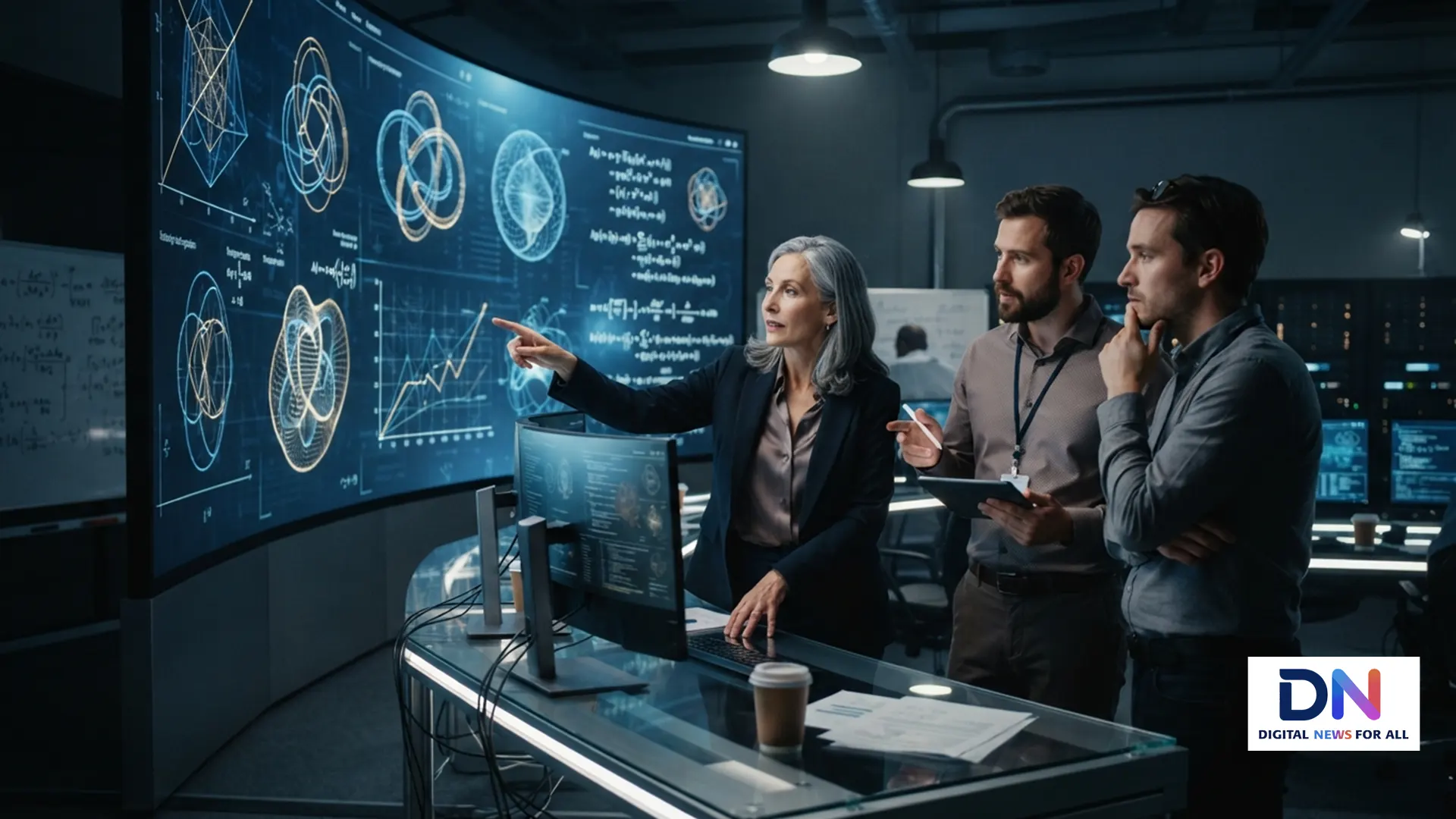
OpenAI math breakthrough headlines are raising a bigger question about artificial intelligence: how far can AI go in work once reserved for highly trained experts? On October 6, 2026, OpenAI published hundreds of mathematical research manuscripts generated with an internal frontier model, signaling a major step in AI-assisted scientific discovery.
According to OpenAI’s announcement, the release includes new mathematical results, proof formalizations and details about how the work was produced. Axios reported that the collection contained 722 manuscripts grouped into 372 families of findings. These are research claims for the mathematical community to examine, not 372 independently confirmed breakthroughs.
What Makes This AI Math Breakthrough Significant?
The release explores difficult problems in advanced mathematics and theoretical computer science. AI systems can now help generate arguments that researchers may need substantial time to investigate, check and develop.
OpenAI says many proofs are being formalized using Lean, a programming language that enables mathematical arguments to be checked by a computer. This matters because mathematical research requires more than a convincing explanation: each logical step must withstand scrutiny.
In August, OpenAI also described ten advances involving areas such as geometry, coding theory and theoretical computer science in its mathematics research release.

Are Software Engineers Officially on Notice?
The implications extend beyond mathematics. AI coding agents already assist with debugging, testing, writing functions and handling complex programming tasks. As these systems improve, engineers may spend less time producing routine code and more time defining requirements, reviewing architecture and ensuring reliability.
However, software engineering involves far more than generating code. Developers must understand business needs, manage security risks, integrate legacy systems and maintain software over time. The OpenAI coding-evaluation research itself highlights how difficult it can be to measure real engineering performance reliably.
Why Experts Are Urging Caution
The mathematical community has not accepted every AI-generated result as settled science. In an October 8 report, TechCrunch examined concerns about human understanding, peer review and discrepancies between some natural-language proofs and their formal versions.
Those concerns do not automatically invalidate the work. They show why independent verification remains essential before researchers rely on a proposed result.
The Institute for Advanced Study hosts an advisory group focused on mathematics and AI. Its broader concerns include making sure that major AI-generated discoveries are understandable and useful to human researchers.
What Happens Next?
The OpenAI math breakthrough could accelerate scientific discovery and change how technical professionals work. But it does not establish that software engineers are obsolete or that every published AI proof is correct.
The likely near-term shift is toward collaboration: AI systems generate and explore solutions, while people evaluate results, establish priorities and take responsibility for real-world outcomes. For engineers, the challenge is to learn how to use these tools effectively while strengthening the judgment and system-level thinking that reliable software still demands.
#OpenAI #ArtificialIntelligence #MathBreakthrough #SoftwareEngineering #AIResearch #FutureOfWork #TechNews