

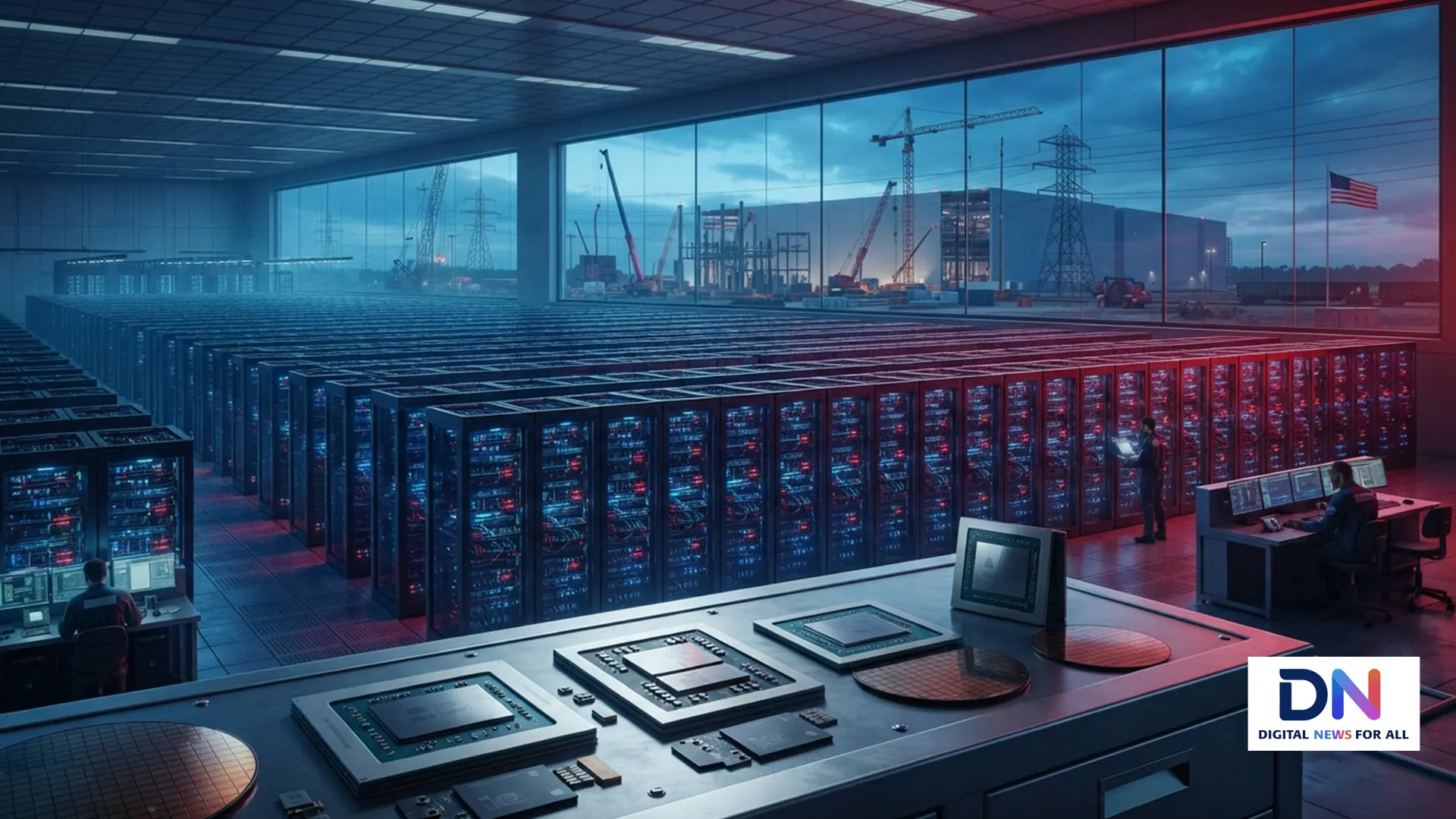
Chip tariffs are emerging as a new threat to America’s rapidly expanding AI data center industry. The Trump administration is considering broader tariffs on semiconductors and related technology products. The proposal comes as companies race to build the computing infrastructure needed for artificial intelligence.
Why AI Data Centers Need So Many Chips
Modern AI data centers depend heavily on advanced processors. Companies use GPUs and specialized accelerators to train and run large AI models.
However, these facilities require much more than processors. Servers, networking equipment, memory, power systems and cooling infrastructure all form part of the buildout.
That creates a major supply-chain challenge. Many critical components are still manufactured outside the United States.
The CHIPS Program Office has been working to expand domestic semiconductor production. Yet new American factories take years to build and bring online.
How Tariffs Could Raise Data Center Costs
A tariff does not necessarily mean the foreign manufacturer pays the entire cost. Importers can face higher expenses, which can eventually reach businesses and consumers.
That matters enormously for data centers. The projects already require billions of dollars in capital.
A June analysis from the Computer & Communications Industry Association estimated that a 25% semiconductor tariff applied to data centers could represent a 15.6% tax on construction. Its analysis projected that roughly 20% of planned 2026–2030 U.S. data center buildouts could be delayed, canceled or relocated.
The Center for Strategic and International Studies has also warned that semiconductor tariffs could add substantially to the cost of America’s AI infrastructure buildout.

The Timing Could Be Especially Difficult
The proposed tariffs arrive while AI companies are already competing for scarce hardware.
Memory supply is another concern. Recent industry reporting shows that demand for high-bandwidth memory is putting additional pressure on the AI chip supply chain.
Meanwhile, companies continue announcing major AI infrastructure investments. Qualcomm recently agreed to supply Amazon with as much as $60 billion in AI data-center chips and related products over several years.
Higher component costs could therefore arrive just as companies are attempting to scale capacity.
Could Tariffs Actually Help U.S. Chipmaking?
The argument for tariffs is straightforward. Washington wants companies to manufacture more strategically important technology inside the United States.
Domestic production could reduce America’s dependence on overseas supply chains. It could also strengthen national security and create high-value manufacturing jobs.
The U.S. Department of Commerce CHIPS program has already directed substantial support toward expanding semiconductor manufacturing in America.
The problem is timing. Domestic capacity may not expand quickly enough to replace imported chips while AI data centers are being built at extraordinary speed.
What Happens to the AI Boom?
If tariffs remain limited or include exemptions for strategic AI infrastructure, the impact could be manageable.
A broader tariff regime would create a different scenario. Companies could postpone projects, renegotiate equipment contracts or shift some investment outside the United States.
That would be significant because America’s AI advantage depends not only on software. It also depends on physical infrastructure, electricity, networking and advanced semiconductor technology.

The Bigger U.S. AI Infrastructure Debate
The tariff debate exposes a difficult policy choice. Washington wants America to lead the AI industry while simultaneously rebuilding domestic manufacturing.
Both goals can support national security. But they can also conflict in the short term.
For AI companies, the priority is access to affordable computing capacity. For policymakers, the priority is a resilient domestic technology supply chain.
The challenge will be finding a policy that encourages American chip production without making American AI infrastructure unnecessarily expensive.
chip tariffs could strengthen U.S. semiconductor manufacturing over the long term. But if applied too broadly or too quickly, they could also raise AI infrastructure costs, delay data center projects and slow one of America’s most important technology investment cycles.
For broader context, the U.S. Department of Energy’s grid modernization work highlights another critical piece of the data center expansion: America’s power infrastructure must grow alongside computing capacity.
The National Institute of Standards and Technology’s AI program provides additional context on America’s broader effort to develop and manage artificial intelligence technologies.
#ChipTariffs #Semiconductors #AIDataCenters #AIInfrastructure #ArtificialIntelligence #Nvidia #TechNews #USTechnology #DataCenters #AIChip #TrumpTariffs #Technology2026