

 By Vinod Ram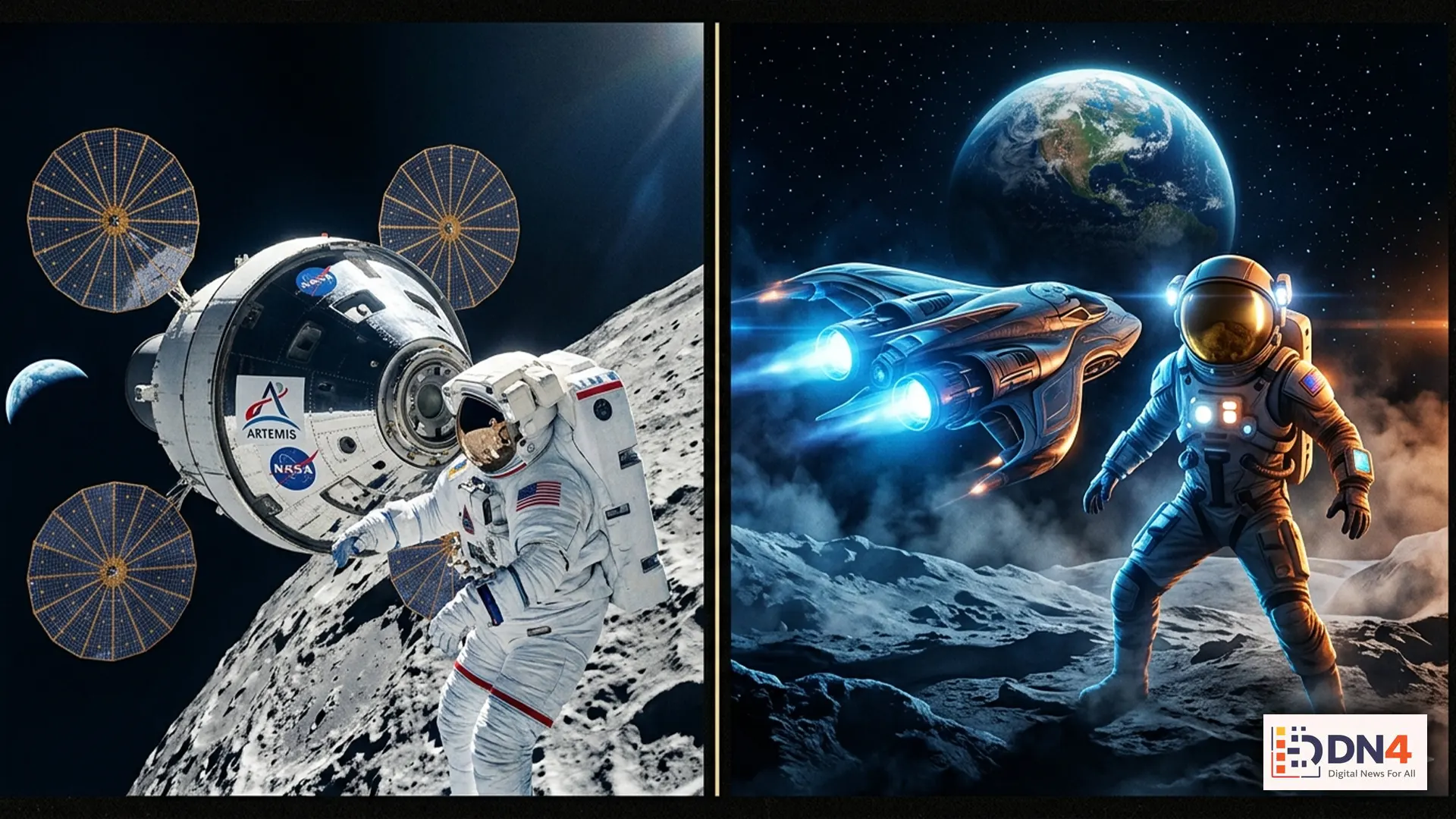
Space movies love the Moon. They love danger, silence, sacrifice, and the idea that one wrong move can turn a mission into history.
But this time, the real story may be just as compelling.
NASA’s Artemis II will send four astronauts around the Moon on the agency’s first crewed lunar mission in more than 50 years. Unlike most Hollywood missions, this one is not fiction, not fantasy, and not built around a rogue AI or a disaster designed for a third-act rescue. It is a real, high-stakes test flight that could define the next era of human space exploration. NASA says Artemis II is a roughly 10-day crewed lunar flyby using the Orion spacecraft and the Space Launch System (SLS), with launch targeted for April 2026.
So how does Artemis II compare with Hollywood’s best Moon missions?
Surprisingly well.
What Artemis II Actually Is
Before comparing it to movies, it helps to understand what Artemis II will actually do.
Artemis II is not a lunar landing. It is a crewed flyby mission. NASA will send four astronauts around the Moon and back to Earth to test the systems needed for deeper lunar missions. The crew includes Reid Wiseman, Victor Glover, Christina Koch, and Jeremy Hansen. NASA describes the mission as the first crewed test of Orion and SLS, designed to validate life support, deep-space operations, and mission procedures for future surface missions.
In Hollywood terms, Artemis II is the part of the movie before the giant plot twist — except in real life, that “setup” is the whole point.
1. Apollo 13: The Gold Standard for Space Drama
If any film still defines realistic Moon-mission storytelling, it is Apollo 13.
That movie worked because it never needed aliens, lasers, or impossible science. It built suspense out of systems, teamwork, and the brutal fragility of spaceflight.
Artemis II shares that same DNA.
Like Apollo-era missions, Artemis II is about engineering confidence under pressure. Every system matters. Every checklist matters. Every human decision matters.
The difference is that Apollo 13 became famous because something went wrong. Artemis II matters because NASA wants to prove things can go right before astronauts return to the lunar surface.
2. First Man: The Human Cost of Lunar Ambition
First Man showed something many space films avoid: spaceflight is not just inspiring. It is physically exhausting, emotionally isolating, and psychologically intense.
Artemis II will not dramatize that with Oscar-style silence and close-up cockpit panic. But the human stakes are still very real.
NASA says this mission will carry astronauts farther from Earth than any crew has traveled in more than half a century. The flight also serves as a deep-space systems test with humans aboard, which means crew performance, health, communication, and endurance all matter.
That makes Artemis II less flashy than a movie — but arguably more impressive.
3. Interstellar: Big Ideas, Beautiful Fiction
Interstellar gave audiences one of the most visually ambitious space journeys ever filmed.
It also gave us wormholes, time distortion, and emotional monologues inside a black hole.
Artemis II will offer none of that. Which is, frankly, rude of NASA.
But where Interstellar wins on spectacle, Artemis II wins on relevance. This is not a symbolic voyage. It is part of a larger lunar strategy meant to support future Moon missions and eventually Mars planning. NASA says Artemis is designed to build long-term deep-space capability, not just repeat Apollo for nostalgia.
Hollywood asks, “What if humanity had to leave Earth?” Artemis asks, “What do we need to master before we can live and work beyond it?”
4. Moon and the Isolation Factor
Films like Moon succeed because they understand one timeless truth about space: even when nothing explodes, space is strange.
Artemis II will not be a lonely one-man lunar psychological spiral. But it will push humans back into deep space after a very long gap.
That alone gives the mission a strange emotional power.
For decades, human spaceflight has mostly lived in low Earth orbit. Artemis II breaks that comfort zone. It reminds the world that there is still a meaningful difference between orbiting Earth and leaving Earth behind.
5. The Martian: Competence Is Cool Again
One reason The Martian connected with audiences is simple: it made competence exciting.
Artemis II has the same advantage.
This mission is not built around chaos. It is built around preparation, procedure, and technical discipline. That may sound less cinematic than disaster, but it often creates stronger real-world tension because there is no script waiting to save anyone.
Where Hollywood Still Wins
To be fair, movies still do a few things better.
- They compress time. Real missions involve years of testing, delays, engineering reviews, and public scrutiny.
- They personalize conflict faster. NASA missions are collaborative by design, not built around one emotionally broken genius.
- They exaggerate danger. Real spaceflight is dangerous, but it usually looks more procedural than explosive.
In short, Hollywood gives us emotional shorthand. Artemis II gives us the harder truth: space exploration is slow because failure is expensive.
Why Artemis II Might Be Better Than Fiction
The biggest reason Artemis II matters is not that it resembles a great space movie.
It matters because it reopens a chapter that many people assumed had become symbolic rather than active.
For the first time in generations, humans are preparing to go back around the Moon not to relive history, but to build on it.
That gives Artemis II something even Hollywood struggles to fake: genuine historical weight.
If Hollywood’s best Moon missions taught us anything, it is that audiences do not just love space because it looks beautiful. They love it because space exposes what humans are made of.
That is exactly why Artemis II matters.
It may not have a Hans Zimmer score or a last-second oxygen miracle. But it does have four astronauts, one spacecraft, a real Moon, and a mission that could shape the next 20 years of exploration.
And honestly, that is a better story than most fiction.
#ArtemisII #NASA #MoonMission #SpaceExploration #Apollo13 #Interstellar #FirstMan #SpaceMovies #ScienceNews