

Artificial intelligence has already transformed how humans work on Earth. Now, it is preparing to do the same in orbit.
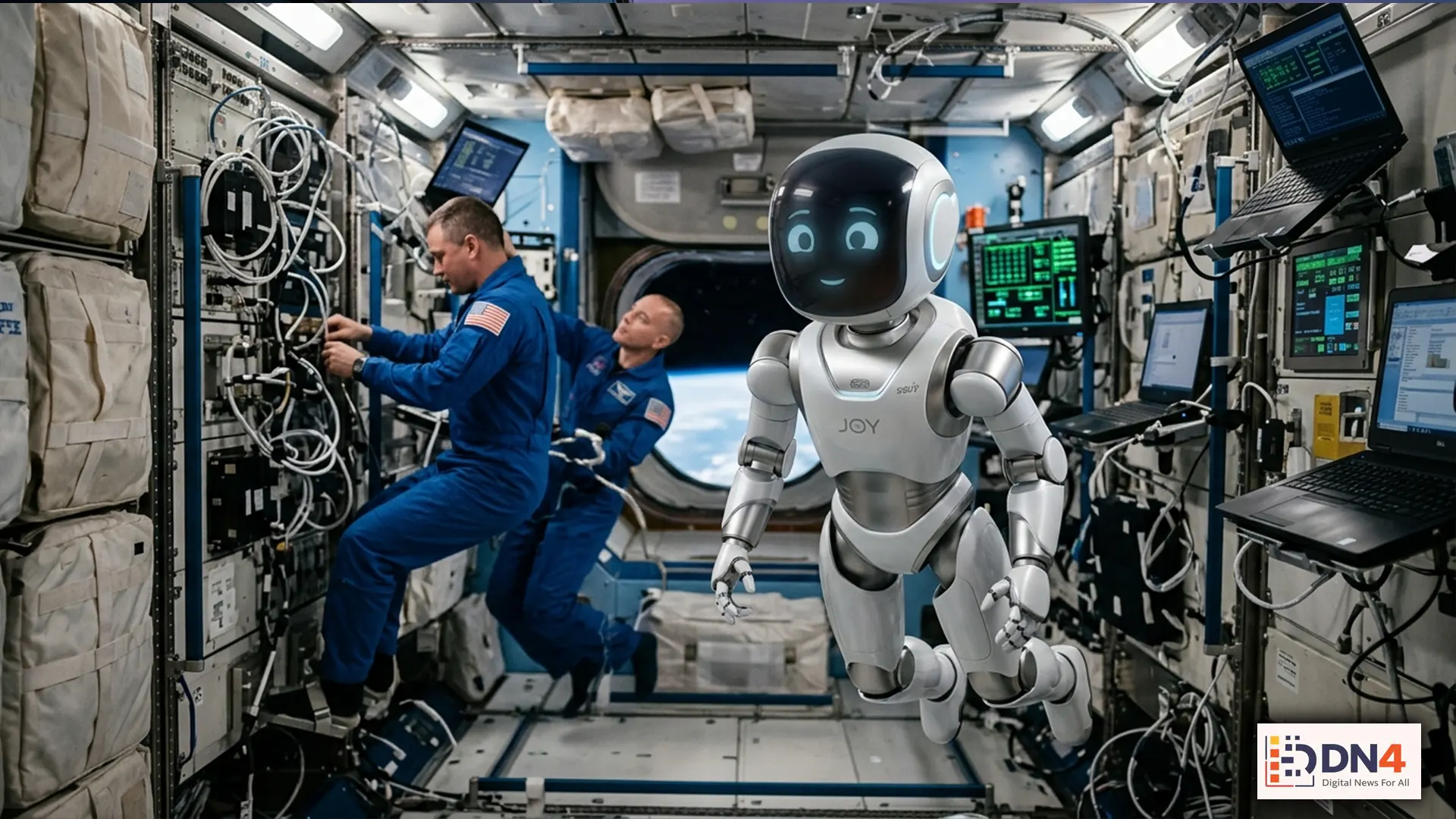
A new generation of space robotics is beginning to move beyond automated arms and software systems into something more interactive, adaptive, and surprisingly human-facing. At the center of that shift is “Joy” — an embodied AI robot designed to help astronauts aboard the International Space Station (ISS).
Joy is not just another experiment in futuristic hardware. It represents a bigger turning point in how humans and machines may work together in space. If successful, embodied AI systems like Joy could become standard crew support tools on future missions to the Moon, Mars, and beyond.
What Exactly Is Joy?
Joy is part of a growing class of embodied AI systems — artificial intelligence designed not just to think or respond through software, but to physically operate and interact within a real-world environment.
Unlike a chatbot or voice assistant, embodied AI exists in physical form. That means it can potentially observe environments, interpret tasks, move through space, interact with equipment, and support human teams in dynamic ways.
In the context of the ISS, that matters enormously. Space is one of the most demanding work environments imaginable. Astronauts manage tightly scheduled tasks, scientific experiments, equipment monitoring, maintenance routines, and emergency protocols — all inside a physically constrained, high-risk environment where every second counts.
An AI system like Joy is being developed to reduce that operational burden and help make space crews more efficient, responsive, and supported.

Why the ISS Is the Perfect Testing Ground
The ISS has long served as a laboratory not just for science, but for the future of human systems design. It is where engineers and researchers test what humans will need if they are going to live and work farther from Earth for longer periods.
That includes robotics.
Historically, robots in space have often been limited to specialized roles. Systems like Astrobee have already shown how free-flying robotic assistants can support station operations through mobility, monitoring, and automation. But Joy signals something more advanced: a shift toward robots that are not only useful, but collaborative.
This is the key difference. Joy is not being imagined as a replacement for astronauts. It is being designed as a teammate.
What Joy Could Actually Do in Orbit
While the full long-term capabilities of embodied AI in space are still evolving, the promise of a system like Joy lies in practical mission support.
Potential functions could include:
- Helping astronauts locate tools and equipment
- Monitoring procedures and checklists in real time
- Providing contextual task guidance during maintenance or experiments
- Assisting with diagnostics, onboard observations, and routine workflows
- Serving as an interactive interface between astronauts and AI systems
In other words, Joy could act like a hybrid of mission assistant, robotic helper, and intelligent support layer — all embedded directly into the living and working environment of the station.
That kind of support becomes even more valuable as missions become longer, more isolated, and more operationally complex.
Why Embodied AI Matters More Than Regular AI
There is a major difference between AI that can answer questions and AI that can function in the physical world. Embodied AI introduces a much harder challenge — but also a much bigger opportunity.
To work effectively in space, a robot like Joy must do more than generate language or process commands. It must interpret context, adapt to unpredictable conditions, and operate safely around humans and sensitive equipment.
That makes embodied AI especially important for future exploration missions, where crew members may not always have instant communication with Earth or enough hands available to handle every routine task manually.
As agencies and private companies think about lunar bases, orbital habitats, and deep-space travel, robots like Joy may become essential not because they are impressive, but because they are practical.
The Human Side of Space Robotics
One of the most fascinating aspects of Joy is that its significance is not purely technical. It is also psychological and cultural.
Long-duration missions can be mentally demanding. Isolation, confinement, and repetitive routines can create cognitive strain even for highly trained astronauts. An interactive robotic assistant — especially one designed to feel intuitive, responsive, and socially usable — could help reduce friction in everyday station life.
This is where embodied AI becomes more than machinery. It becomes part of the crew experience.
That does not mean astronauts need a “robot friend” in the science-fiction sense. But it does suggest that future mission design may increasingly consider how machines can support not just operational performance, but human wellbeing and cognitive efficiency.
What Joy Means for the Future of Space Exploration
Joy’s biggest importance may not lie in what it does on the ISS today, but in what it could make possible tomorrow.
If embodied AI proves reliable in orbit, it could become foundational for future space missions where autonomy matters even more. On the Moon or Mars, astronauts will need systems that can assist locally, make sense of evolving environments, and support decision-making without constant real-time control from Earth.
That means the success of AI robots like Joy could influence everything from habitat design and maintenance workflows to astronaut training and mission safety planning.
In a very real sense, robots like Joy may help determine what sustainable human presence beyond Earth actually looks like.
Why This Story Matters Beyond Space
Even for people who do not follow every ISS development, Joy represents something bigger than one mission.
It is a glimpse into the next phase of AI — where intelligence is no longer confined to screens, but increasingly embedded into physical environments and real-world teamwork.
That has implications far beyond orbit. The same embodied AI concepts that researchers are testing in space could one day influence healthcare, logistics, elder support, hazardous environments, advanced manufacturing, and emergency response here on Earth.
Space has always been a preview of future systems. Joy may be one of the clearest signs yet that AI’s next frontier is not just digital — it is physical.
Joy may look like a futuristic experiment, but it pursues a mission grounded in something very practical: helping humans work better in one of the most difficult environments ever created.
If it succeeds, people won’t just remember Joy as a robot on the ISS. It could become part of the foundation for how humans and AI collaborate in space for decades to come.
And as space exploration moves toward longer, farther, and more autonomous missions, that kind of partnership may become not optional — but essential.
#JoyRobot #ISS #SpaceAI #EmbodiedAI #Astronauts #SpaceRobotics #ArtificialIntelligence #FutureOfSpace