

 By Vinod Ram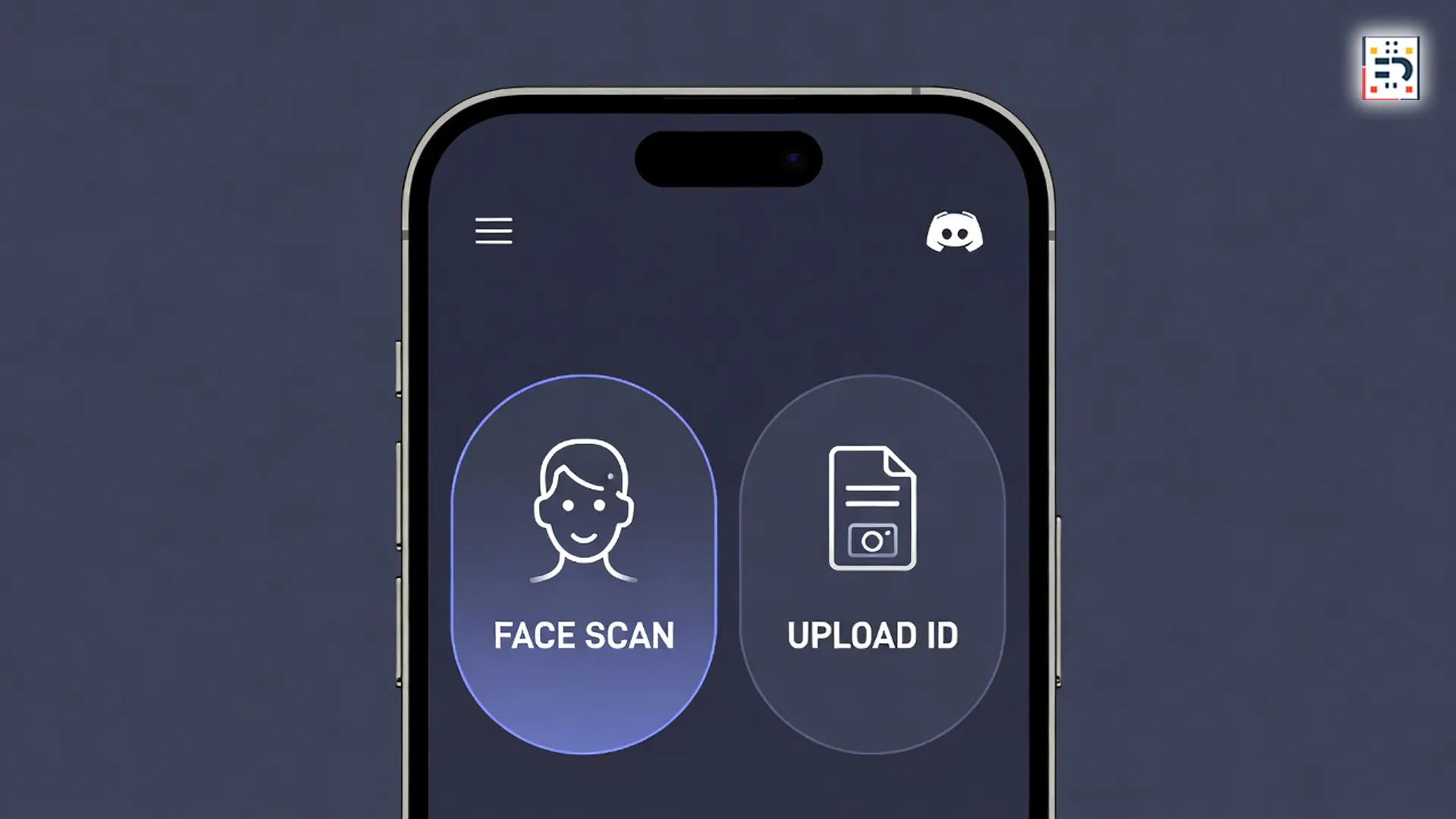
Starting next month, Discord will roll out new age-verification requirements for users in certain regions, forcing millions to choose between AI-powered facial age estimation or uploading a government-issued ID. The move has sparked heated debate over privacy, data security, and digital identity.
Why Discord Is Enforcing Age Verification
Discord says the change is meant to comply with evolving online safety and child protection regulations. According to the company’s official policy updates shared on the Discord Safety Center, platforms hosting user-generated content must take stronger steps to prevent underage access.
Similar pressure has already affected platforms like Meta and TikTok, as governments push for stricter age controls.

Option 1: AI Facial Age Estimation
One option Discord is introducing is Facial Age Estimation, an AI system that analyzes a selfie to estimate whether a user meets the minimum age requirement. Discord states that the scan does not identify who you are—only your estimated age.
This technology is commonly used in digital verification systems discussed by the World Economic Forum, but privacy advocates remain skeptical about biometric data collection.
Pros
- No government ID required
- Fast verification process
- Lower risk of identity theft if implemented correctly
Cons
- Uses biometric facial data
- Accuracy varies by lighting, camera, and demographics
- Trust depends on third-party AI vendors
Option 2: Government ID Submission
The alternative is uploading a government-issued ID such as a passport or driver’s license. This method provides near-perfect accuracy but raises serious data protection concerns.
Cybersecurity experts quoted by the Electronic Frontier Foundation (EFF) warn that centralized ID storage can become a high-value target for hackers.
Pros
- High accuracy
- Widely accepted for legal compliance
Cons
- Shares sensitive personal information
- Higher risk if a data breach occurs
- Longer verification process

Which Option Is Safer for Your Data?
From a privacy-first perspective, many experts argue that facial age estimation may be the lesser risk if images are processed locally or deleted immediately. Research cited by MIT Technology Review suggests biometric minimization is safer than permanent ID storage.
However, transparency is key. Users should carefully review Discord’s data retention policies and whether verification is handled internally or by third-party vendors.
What Users Should Do Before Verifying
- Read Discord’s updated privacy and data retention policies
- Choose the option that exposes the least permanent data
- Avoid using shared or public devices for verification
- Monitor account activity after verification
As age verification becomes the norm across social platforms, users are increasingly forced to trade access for data. Understanding those trade-offs is more important than ever.
#Discord #OnlinePrivacy #AgeVerification #BiometricData #TechPolicy #DigitalRights