

 By Vinod Ram
Oil markets are behaving in a way that few analysts expected. Despite escalating tensions and shipping disruptions around the Strait of Hormuz, global crude prices have remained surprisingly stable near the $88-per-barrel mark.
Historically, any threat to this critical maritime chokepoint — through which roughly one-fifth of the world’s oil supply flows — would trigger dramatic spikes in prices. Yet today’s markets appear calmer, suggesting deeper structural shifts in the global energy system.
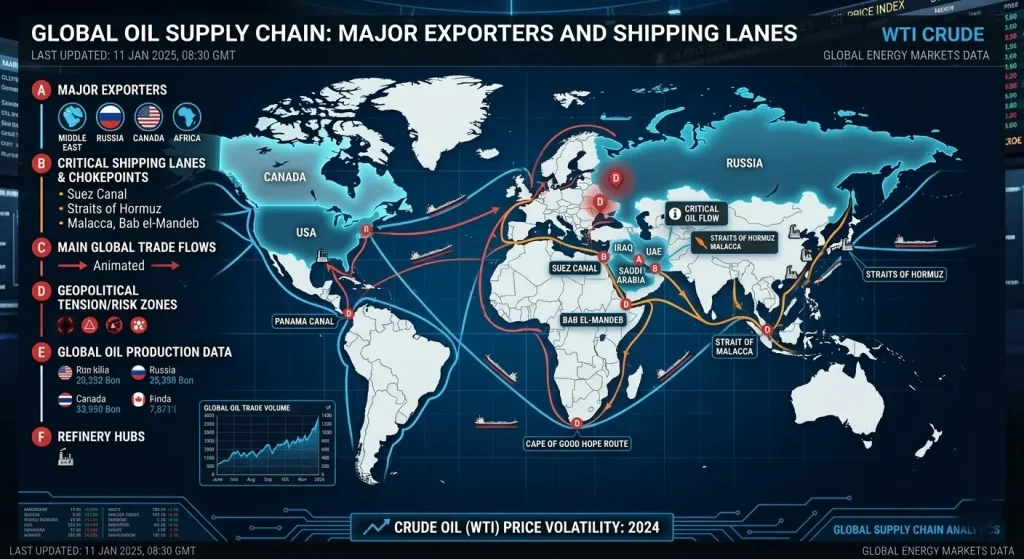
Why the Strait of Hormuz Matters to Global Energy
The Strait of Hormuz is one of the most strategically important shipping routes in the world. According to data from the U.S. Energy Information Administration, nearly 20% of global petroleum liquids pass through the narrow waterway.
Major producers such as Saudi Arabia, the United Arab Emirates, Kuwait, and Iraq depend heavily on this route to export crude to markets in Asia, Europe, and North America.
Even temporary disruptions could theoretically remove millions of barrels per day from the global supply chain — a scenario that historically triggered dramatic price spikes.
Strategic Oil Reserves Are Acting as a Buffer
One key reason prices have remained relatively stable is the availability of strategic petroleum reserves.
Countries like the United States and members of the International Energy Agency maintain large emergency reserves designed to stabilize markets during supply shocks.
These reserves create a psychological and logistical safety net that helps prevent panic-driven buying in energy markets.
Rising Production Outside the Middle East
Another critical factor is the increasing diversification of global oil production. The United States remains one of the world’s largest oil producers thanks to shale production.
According to recent market updates from OPEC, non-OPEC producers — particularly the U.S., Brazil, and Guyana — have expanded supply significantly over the past decade.
This diversification reduces the market’s dependence on a single geopolitical region.
Demand Concerns Are Weighing on Prices
At the same time, oil demand growth is showing signs of slowing in several major economies.
Economic uncertainty in China and Europe has led analysts at International Monetary Fund and other institutions to lower global growth forecasts.
Slower industrial activity means weaker fuel consumption — a factor that helps offset geopolitical supply risks.

Financial Markets Are Less Reactive Than Before
Energy markets today are more sophisticated and better hedged than during previous geopolitical crises.
Institutional investors rely heavily on futures markets such as the CME crude oil futures exchange, where traders can price in geopolitical risks ahead of time.
This advanced risk management infrastructure often dampens the shock effect that once triggered massive price swings.
The Real Question: Could Prices Still Spike?
While the market reaction has been muted so far, analysts warn that the situation remains fragile.
If the Strait of Hormuz were fully blocked for an extended period, the consequences could still be dramatic. Energy analysts estimate that up to 17 million barrels per day of supply could be disrupted.
Such a scenario would likely trigger sharp price spikes and ripple effects across global inflation, transportation costs, and financial markets.
What It Means for the Global Economy
For now, the stability around $88 per barrel suggests that markets are confident supply disruptions will remain manageable.
But the geopolitical risk premium remains embedded in energy prices — meaning volatility could return quickly if tensions escalate.
For consumers and policymakers alike, the situation is a reminder that global energy security remains deeply tied to geopolitics.
#OilPrices #EnergyMarkets #StraitOfHormuz #GlobalEconomy #OilSupply #EnergySecurity #Geopolitics