

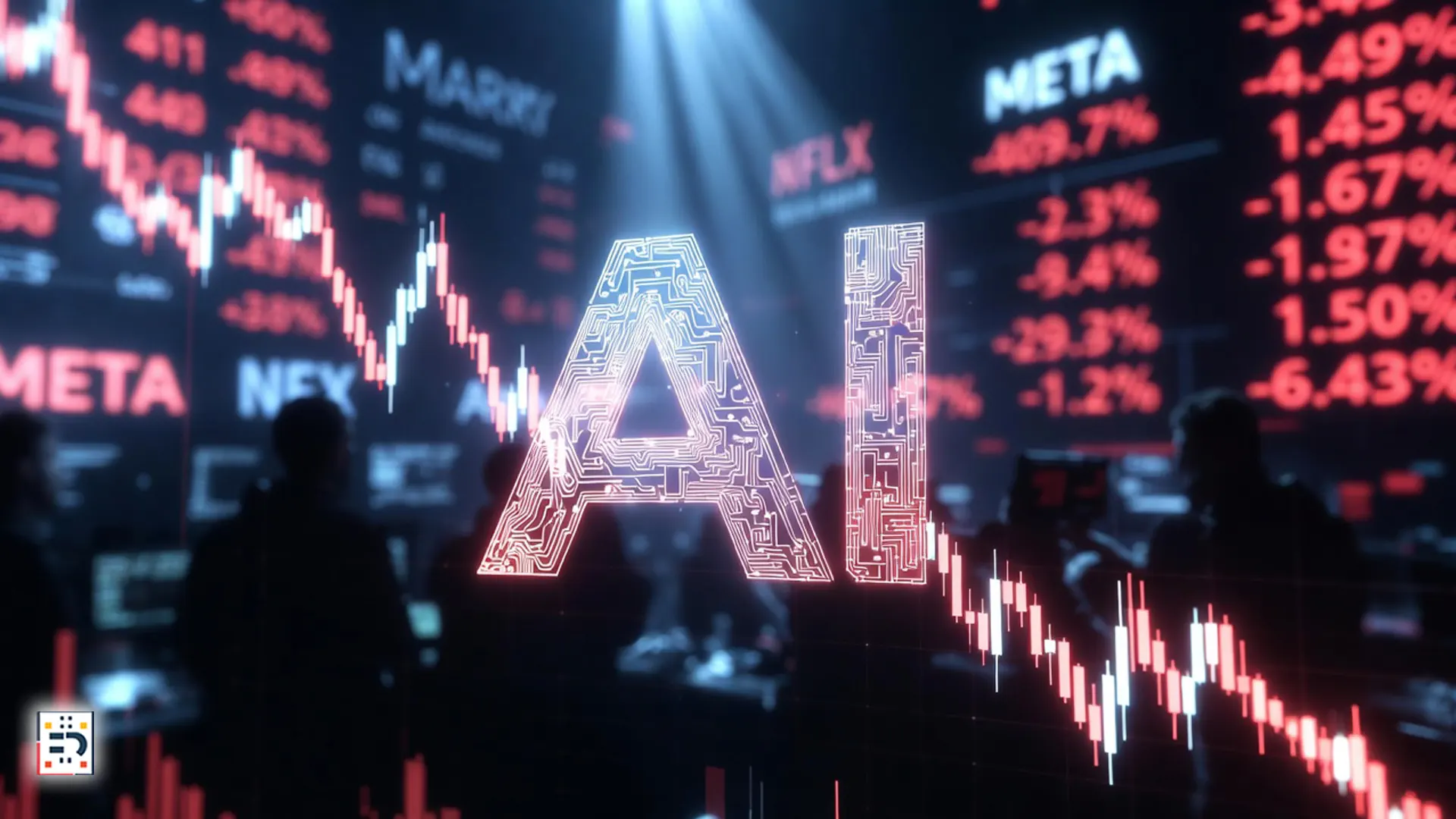
The long-hyped artificial intelligence boom may be hitting its first major reality check. The 2026 AI stock correction has rattled markets, raising concerns that trillion-dollar AI bets are finally colliding with economic and operational limits.
After years of runaway valuations, investors are now asking whether the AI revolution was priced too far, too fast.
What Triggered the 2026 AI Stock Correction?
Several forces converged to cool the once-red-hot AI sector. Rising interest rates, slowing enterprise adoption, and ballooning infrastructure costs have forced a reassessment of growth assumptions.
Major players like NVIDIA and Microsoft saw heightened volatility as analysts recalibrated long-term revenue expectations.

Trillion-Dollar Valuations Under the Microscope
At its peak, the AI sector fueled some of the largest market capitalizations in history. Companies tied to cloud computing, chips, and foundation models surged as capital poured in.
But according to analysis from Bloomberg, earnings growth has struggled to keep pace with infrastructure spending — particularly in energy-hungry data centers.
Where the AI Business Model Is Being Tested
While AI adoption continues, monetization remains uneven. Many enterprises experiment with AI tools without fully scaling them into revenue-driving systems.
Reports from McKinsey suggest AI productivity gains are real, but slower and more complex than early forecasts implied.
Winners, Losers, and Survivors
- Infrastructure-heavy firms face margin pressure
- Vertical AI platforms show stronger durability
- Energy-efficient models gain investor favor
- Speculative startups face funding droughts
Chipmakers, cloud providers, and software firms tied to real enterprise use cases are expected to weather the correction better, according to CNBC.
Is This a Crash or a Healthy Reset?
Market historians compare the moment to past tech resets rather than collapses. Similar to the early cloud-computing era, today’s pullback may help separate hype from sustainable innovation.
As noted by The Wall Street Journal, long-term AI winners will likely emerge leaner, more efficient, and more disciplined.
What Investors Should Watch Next
Key indicators include enterprise spending, energy costs, regulatory clarity, and real productivity metrics. The path forward may be slower — but potentially more durable.
The AI revolution isn’t over, but the era of unchecked optimism may be.
#AIStocks #StockMarketCorrection #ArtificialIntelligence #TechStocks #MarketAnalysis #Investing