

 By Vinod Ram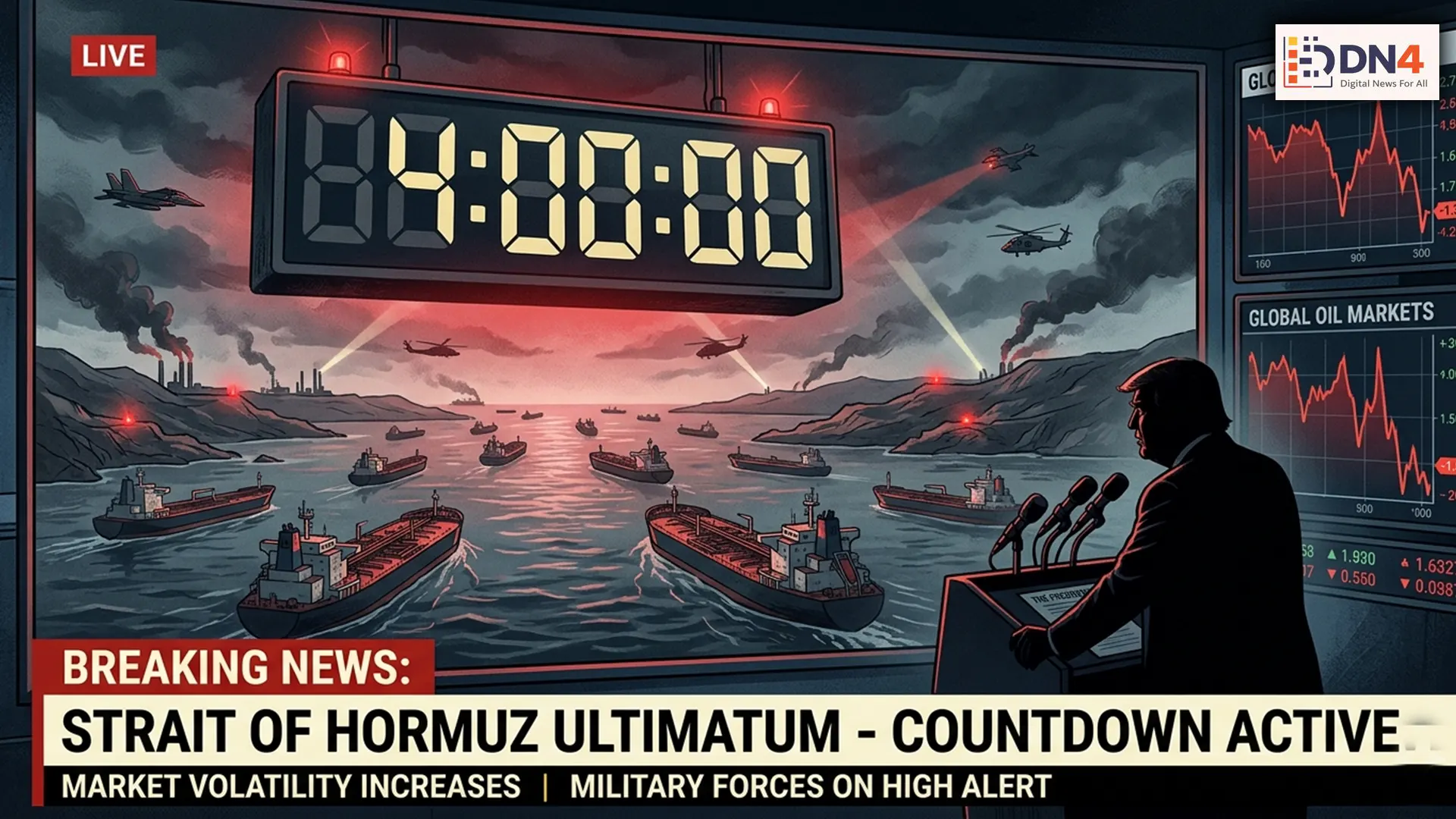
The clock is doing what diplomacy no longer can: forcing a decision. With just hours left before President Donald Trump’s self-imposed 8:00 PM Eastern deadline for Iran to reopen the Strait of Hormuz, the world is watching a geopolitical standoff that has already shaken oil markets, shipping, and risk sentiment across global markets.
This is not just another headline in a long-running Middle East crisis. It is a live test of whether strategic pressure, military brinkmanship, and public ultimatums can force movement in one of the world’s most dangerous energy chokepoints.
And if nothing changes before the deadline, the consequences may not stay regional for long.
Why 8 PM Matters More Than the Rhetoric
Trump’s deadline is tied to one demand above all others: safe and full reopening of the Strait of Hormuz, the narrow maritime corridor through which a major share of the world’s seaborne oil moves every day. According to recent reporting from The Associated Press, Trump had warned that failure to restore transit could trigger sweeping U.S. military action against Iranian infrastructure and strategic assets.
That means the final hours are not just about whether a threat is carried out. They are about whether both sides are trying to preserve room for a last-minute off-ramp.
What’s Actually at Stake Tonight
If the deadline collapses without a deal, the fallout could move fast across several fronts:
- Oil and LNG shipping risk through Hormuz
- War-risk insurance costs for tankers
- Potential military retaliation or escalation
- Higher energy prices feeding global inflation
- Fresh volatility across equities, commodities, and currencies
That is why traders, diplomats, and military planners are all staring at the same clock — but for very different reasons.
Markets Are Pricing Fear, Not Just Supply
The market response to the deadline has not been about barrels alone. It has been about uncertainty.
When a geopolitical crisis centers on a chokepoint like Hormuz, traders are forced to price a series of worst-case possibilities all at once: delayed cargoes, disrupted tanker routes, retaliatory strikes, and a wider regional conflict. Even if actual physical supply remains partially intact, the risk premium can rise sharply because markets hate ambiguity more than they hate bad news.
That’s why every presidential statement, every military movement, and every hint of mediation has mattered so much in the past 24 hours — especially as analysts track Brent crude, freight risk, and defense positioning.
Why Iran May Still Hold the Stronger Tactical Position
Despite the pressure, Iran’s leverage has always rested on one reality: it does not need to “win” conventionally to create global disruption. It only needs to keep uncertainty alive.
That is what makes Hormuz such a dangerous bargaining chip. Tehran knows that even limited threats to tanker traffic can rattle global trade flows, force insurers and shippers to rethink exposure, and raise the economic cost for every government that depends on stable Gulf transit.
In other words, the strait is not just a military issue. It is an economic pressure valve — and Iran knows exactly how much attention it commands.
The Real Wild Card: Will Trump Escalate or Pivot?
The most important unknown is no longer what Iran wants. It is what Trump does if the deadline passes without a clean diplomatic breakthrough.
Recent reporting suggests that after days of maximalist rhetoric, Trump has also shown willingness to pause broader action if a reopening framework is offered. That creates two competing possibilities in the final stretch:
- Escalation scenario: targeted strikes or expanded military operations if Iran is seen as non-compliant.
- Pause scenario: a temporary diplomatic freeze dressed as a “last chance” extension.
And because Trump has publicly tied credibility to the deadline, whatever happens next will be judged not only as policy — but as theater, deterrence, and political messaging all at once.
Why the World Is Watching More Than Washington
This is not just a U.S.-Iran confrontation. It is a global market event with immediate implications for Europe, Asia, and every economy vulnerable to higher energy costs.
For import-heavy countries, Hormuz instability means inflation risk, For shipping and commodity firms, it means cost escalation. For central banks, it means one more external shock in a world already struggling with fragile confidence and geopolitical fragmentation.
That is why this deadline feels bigger than a diplomatic timestamp. It sits at the intersection of war, trade, inflation, and energy security.
The Deadline Is Real Even If the Outcome Isn’t Clear
With four hours to go, one thing is already certain: Trump’s 8 PM deadline has succeeded in doing what markets fear most — creating a narrow window where miscalculation becomes expensive.
Whether tonight ends in strikes, a pause, or a face-saving diplomatic detour, the deeper message is already out. The Strait of Hormuz remains one of the most dangerous pressure points in the world economy, and global markets are still painfully exposed to decisions made in just a few square miles of water.
When the countdown ends, the consequences won’t stop at the Gulf. They’ll echo through fuel prices, freight costs, and financial screens around the world.
#TrumpIran #IranDeadline #HormuzStrait #OilMarkets #Geopolitics #MiddleEastCrisis #GlobalTrade #MarketVolatility #BreakingNews