

 By Vinod Ram
Hollywood’s turning point: creativity meets automation
Although AI once seemed experimental, it now plays a central role across post-production, drafting, voice work and digital doubles. Consequently, studios trim budgets and accelerate timeframes. Meanwhile, writers, actors and VFX artists push back because these tools influence job security, authorship and bargaining power.
How AI changes production workflows
1. VFX and postproduction evolve rapidly
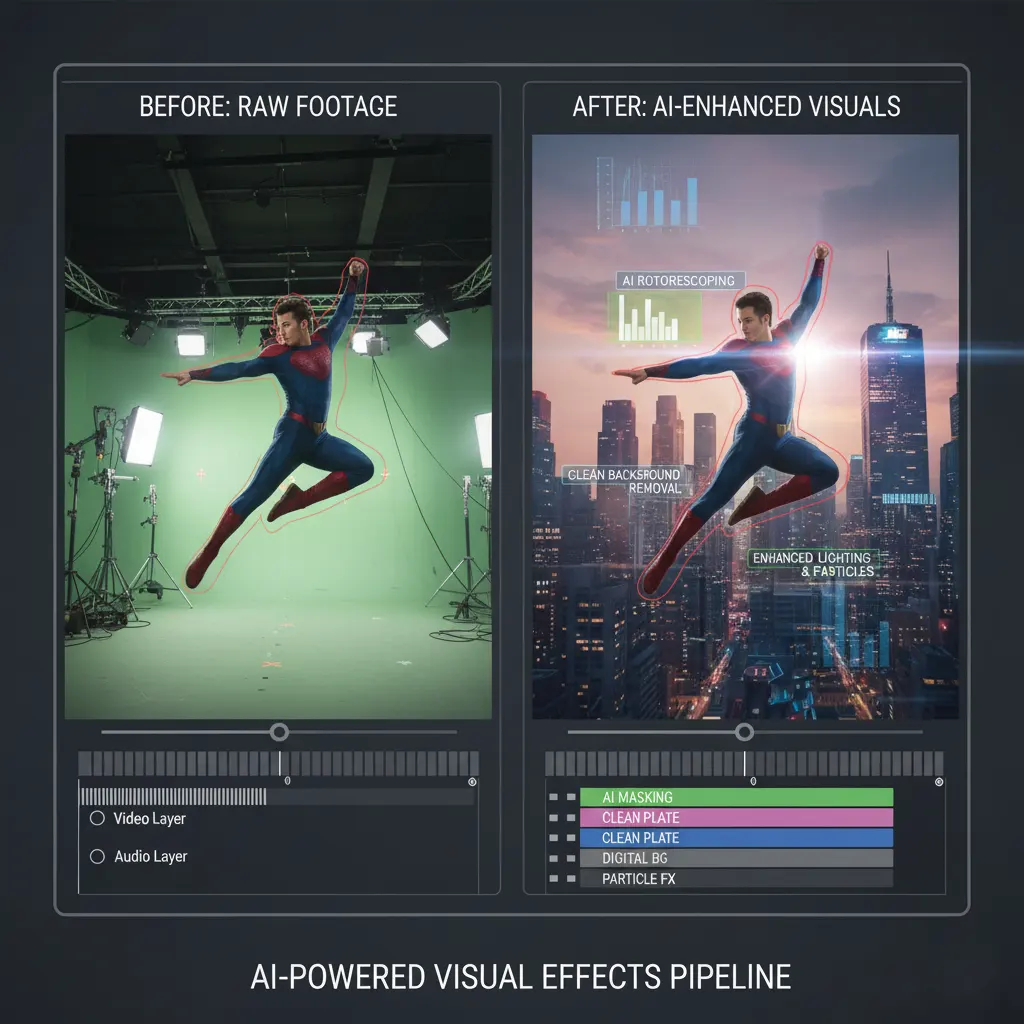
AI now completes tasks such as rotoscoping and cleanup far faster than human teams. As a result, indie filmmakers gain access to studio-level polish, while major productions compress their schedules significantly.
2. Synthetic voices and digital likenesses expand
Studios increasingly use voice cloning and facial synthesis for pickups, localization or new performances. However, this trend sparks intense debate because creators demand consent and compensation whenever their likeness supports AI models.
3. Script development shifts toward hybrid writing
Writers often rely on AI for beat suggestions or early drafts. Nevertheless, the practice raises questions about authorship, especially when models trained on unlicensed materials generate similar stylistic outputs.
4. Digital actors enter the scene
Although still emerging, AI-driven performers already appear in crowd scenes and stunt work. Consequently, many professionals worry that studios might eventually replace some entry-level roles.
Why the disruption matters
Because AI accelerates timelines and reduces costs, studios gain strong financial incentives to adopt it. On the other hand, creators risk losing control of their voices, faces and written material unless they negotiate firm contractual protections. Moreover, unresolved legal gray areas—particularly around training data—create long-term uncertainty.
Where unions and the law are headed
During the latest labor negotiations, major guilds pushed for clearer AI rules. As a result, new contracts include notice requirements, consent standards and limits on replacing performers without agreement. Even so, lawmakers continue drafting legislation because studios and creators disagree on how far AI rights should extend.
10 practical steps creators should take now
- Add AI-specific clauses. For example, insist on written consent before anyone uses your likeness or voice for synthetic purposes.
- Use narrow, revocable licenses. This approach prevents unrestricted AI training or reuse.
- Negotiate revenue shares. When studios reuse your digital assets, request residual-style payments.
- Track provenance. Provide watermarked references to detect unauthorized copies more easily.
- Separate performance rights. Treat voice, motion-capture data and likeness as distinct assets.
- Request transparency in training data. Ask whether the studio used your past work to train any model.
- Learn essential AI tools. Consequently, you stay competitive and produce pitch-ready samples faster.
- Support collective licensing programs. Guild-backed pools strengthen your leverage.
- Secure human-only credit windows. This strategy protects early distribution visibility.
- Work with AI-literate attorneys. Their guidance ensures enforceable, future-proof contracts.
New opportunities for creators
Although AI introduces risks, it also opens fresh income channels. For instance, performers can license digital doubles, produce multilingual voice packs or sell access to authenticated “creator models.” Additionally, small teams can now pitch higher-quality concepts because AI speeds up prototyping.

Case study: responsible AI adoption in indie film
An independent director used AI rotoscoping and background generation, which reduced postproduction costs by nearly 40%. Meanwhile, the lead actor licensed a voice pack and received recurring revenue from synthetic usage. Because contracts included strict no-training rules, both parties retained full creative control.
Useful tools and platforms
- AI-assisted VFX tools for cleanup and rotoscoping
- Verified voice-cloning platforms with transparent audit logs
- Script-assist software with provenance tracking
- Rights and contracts platforms designed for AI workflows
How studios should navigate AI ethically
To move forward responsibly, studios should disclose AI usage, collect explicit consent and include revenue-sharing models for synthetic reuse. Furthermore, they need to embed provenance metadata to ensure traceability. By doing so, they build trust and reduce future legal risks.
Ultimately, AI rewards creators who adapt early. When artists adopt the technology, negotiate smart contracts and protect their rights, they gain the leverage to benefit from synthetic media rather than lose ground to it. Therefore, understanding AI’s role today prepares creatives for tomorrow’s entertainment economy.
External Links
- James Cameron on AI actors (The Guardian)
- SAG-AFTRA position on AI performer rights
- Tilly Norwood AI actress controversy (Entertainment Weekly)
- SAG-AFTRA files unfair labor charge over AI Darth Vader voice
- Cameron warns AI-generated performances are “the opposite of cinema” (Times of India)
- AI actors spark backlash (TechRadar)
#AIinHollywood #FilmTech #AIFuture #DigitalActors #VFX #CreatorRights #Filmmaking #AIEthics #EntertainmentTech